

Have you ever wondered why some people seem naturally brave while others are more cautious? In Vedic astrology, Mars (also called Mangal or Kuja) plays a big role in shaping these qualities. This red planet holds immense power over our courage, energy, and how we handle challenges in life.
Think of Mars as your inner warrior. When you face a difficult situation, Mars determines whether you’ll charge ahead fearlessly or hold back. The ancient sages who wrote the Brihat Parashara Hora Shastra (BPHS) understood this planet’s influence deeply. They recognized that Mangal affects everything from your physical strength to how you fight life’s battles.
Let’s explore what makes this fiery planet so special. We’ll break down the ancient wisdom from BPHS into simple, practical insights that you can use in daily life.
Tattva (Element) of Mars
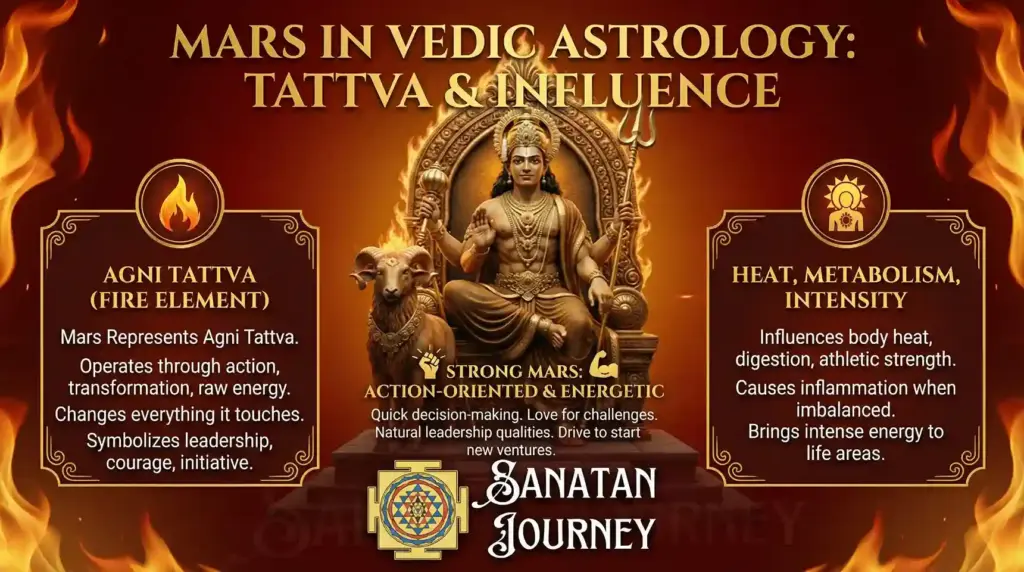
So, what’s the basic element of Mars? According to BPHS, Mangal belongs to the Agni Tattva – the fire element. This isn’t just poetic language; it tells you everything about how this planet operates.
Fire transforms things, right? When you light a match, it changes everything it touches. Similarly, Mars transforms situations through action and energy.
The textbook “Brihat Parashar Hora Shastra” confirms that “Mars governs leadership, enterprise” because of its fiery nature.
What does this fire element mean for you? If Mars is strong in your chart, you’ll notice these qualities:
- You take quick action rather than overthinking
- You feel energized by challenges instead of avoiding them
- You prefer starting new projects over maintaining old ones
- You naturally lead rather than follow
The fire element also connects Mars to your body’s heat and digestion. In Ayurveda (India’s traditional medicine), fiery planets like Mangal create Pitta – the heat in your body.
This explains why people with prominent Mars often have:
- Higher body temperature
- Stronger digestive fire (metabolism)
- Tendency toward inflammation or fever when unbalanced
- Athletic, muscular builds
Here’s something interesting: BPHS places Sun in a similar category, but Mars specifically rules the fire element.
Think of Sun as the source of all fire, while Mars represents fire in action – like the difference between sunlight and a burning flame.
You can see Mars’s fire element in professional fields too. Engineering, metallurgy, working with furnaces, and handling sharp tools – all these involve transformation through heat and force. That’s pure Mars energy at work.
The ancient text also tells us that Mars rules “Greeshma Ritu” – the summer season. This makes perfect sense. Summer brings intense heat, just like Mars brings intense energy to whatever it touches in your chart.
When Mars occupies fiery signs (Aries, Leo, or Sagittarius), this fire element doubles up. You get someone who’s naturally dynamic, courageous, and ready to take risks.
But if Mars sits in watery signs like Cancer (where it’s actually debilitated), the fire struggles to burn properly. It’s like trying to light a match in the rain – frustrating and ineffective.
Nature of Mars
Now, here’s the big question: Is Mars a friend or foe? According to BPHS, Mangal is a Krura Graha – a natural malefic planet. Before you panic, let me explain what this really means.
“Malefic” doesn’t mean “bad.” It simply describes Mars’s method of operation. The textbook explains: “Sun, Mars, Rahu and Ketu are natural malefics”. These planets work through challenge, friction, and force – not through gentleness and harmony.

Think of it this way: Would you call a gym workout “malefic” because it’s tough? No! The difficulty makes you stronger. That’s exactly how Mars operates. It creates challenges that build your character and strength.
BPHS categorizes planets based on how they deliver results. Jupiter and Venus are “Saumya Grahas” (benefics) – they give results smoothly, like a gentle river flowing. Mars, being a Krura Graha, pushes you through obstacles like a warrior breaking through enemy lines.
What makes Mars malefic in practice?
Physical Aggression: Mars rules over weapons, sharp objects, and physical force. When afflicted, it can indicate accidents, injuries, or surgical procedures. You’ll find Mars prominent in charts of surgeons, soldiers, and athletes – professions requiring controlled aggression.
Mental Qualities: The Brihat Parashara Hora Shastra describes Mars as having “blood-red eyes” and being “given to anger”. This shows the planet’s connection to irritability and quick temper. People with strong Mars don’t easily forgive offenses.
Confrontational Energy: While benefics like Venus create harmony in relationships, Mars creates friction. BPHS explains that Mars naturally signifies “enemies” and the 6th house (house of conflicts and competition). This doesn’t mean Mars people make enemies – it means they don’t shy away from confrontation when necessary.
However – and this is important – Mars’s malefic nature serves a purpose. The ancient text reveals that Mars is the “Senapati” (commander-in-chief) in the planetary cabinet. Every kingdom needs a strong military leader. That’s Mars’s job in your chart.
You need Mars’s malefic energy when:
- Competitors challenge your position at work
- You must defend your rights or property
- Physical courage is required in dangerous situations
- Discipline and hard work are necessary for success
Here’s something fascinating: BPHS assigns Mars a Tamasic Guna. In Hindu philosophy, Tamas represents darkness, but it also means the ability to destroy what needs destroying.
Sometimes you need to demolish an old building before constructing a new one, right? That’s Tamasic Mars energy.
The textbook also mentions that despite being malefic, “Mars and Saturn are tamasik planets,” and Mars belongs to the “Kshatriya” (warrior) class.
This warrior nature can manifest as either protective courage or destructive violence, depending on Mars’s condition in your chart.
Want to know if Mars will act positively for you? Check its strength and placement. When Mars sits in its own signs (Aries or Scorpio), exaltation (Capricorn), or forms beneficial yogas, it becomes your greatest ally. Even malefics give excellent results when properly placed and strong.
Remember: The sages who wrote BPHS weren’t labeling planets as “good” or “bad.” They were describing operational styles.
Mars operates through challenge and conflict – that’s its nature. Your job is to channel this energy constructively through sports, technical work, or standing up for what’s right.
Karakatva of Mars
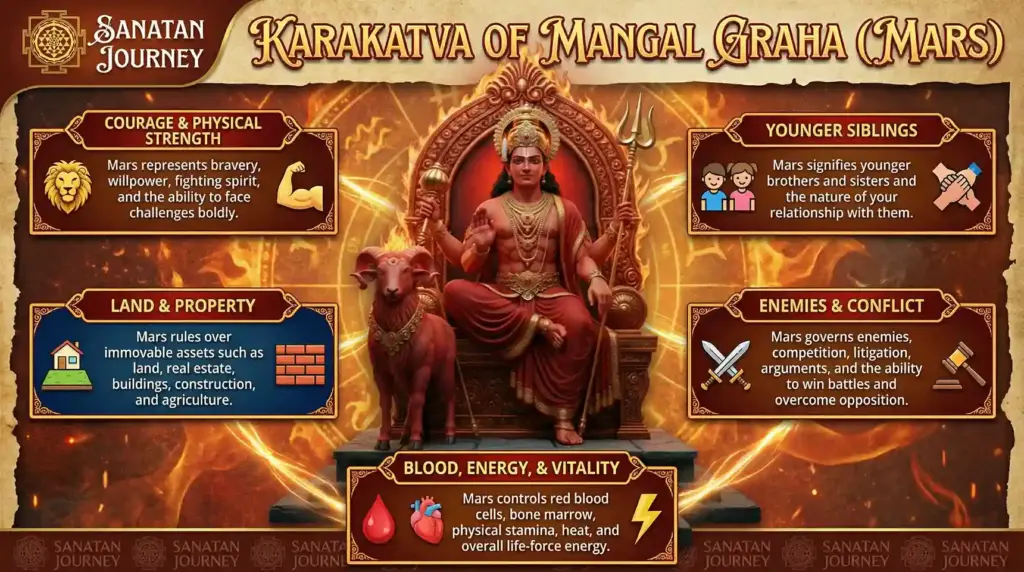
In the ancient book Brihat Parashara Hora Shastra (BPHS), every planet is given specific jobs or things it represents. These are called “Karakatvas” or significations. Think of them as the departments that Mars is in charge of in your life.
According to the ancient texts, Mars is the “Naisargika Karaka” (natural significator) for many important things. Here is a simple list of what Mars controls in your life:
Courage and Strength: Mars is the source of your bravery (Parakrama). It decides how much physical strength and mental willpower you have to fight tough situations.
Younger Siblings: Just as Jupiter represents older siblings, Mars represents your younger brothers and sisters. It shows the quality of your relationship with them.
Land and Real Estate: Do you dream of owning a house or a piece of land? Mars is the planet behind all immovable property (Bhoomi). It rules over buildings, construction, and agriculture.
Enemies and Battles: Mars is the warrior planet. It signifies your enemies (Satru) and your ability to defeat them. It also rules over litigation, arguments, and winning competitions.
Blood and Bone Marrow: In your body, Mars rules over the red blood cells and the bone marrow (Majja). It is responsible for your energy levels and physical vitality.
Fire and Heat: As a fiery planet (Agni Tattva), Mars controls fire, electricity, weapons, and anything that burns or cuts. This is why it is linked to chefs, engineers, and surgeons.
Wounds and Accidents: Because Mars is aggressive, it also signifies cuts, burns, injuries, and surgical operations.
Debt and Loans: The 6th house is the house of debts, and Mars is a key player here. It can show both the burden of loans and the energy to pay them back.
Logic and Technical Skill: While Mercury gives intelligence, Mars gives the technical logic needed for engineering, mechanics, and fixing things.
Passion and Ambition: Mars is the fuel for your desires. It gives you the passion to chase what you want and the ambition to succeed.
Drishti of Mars
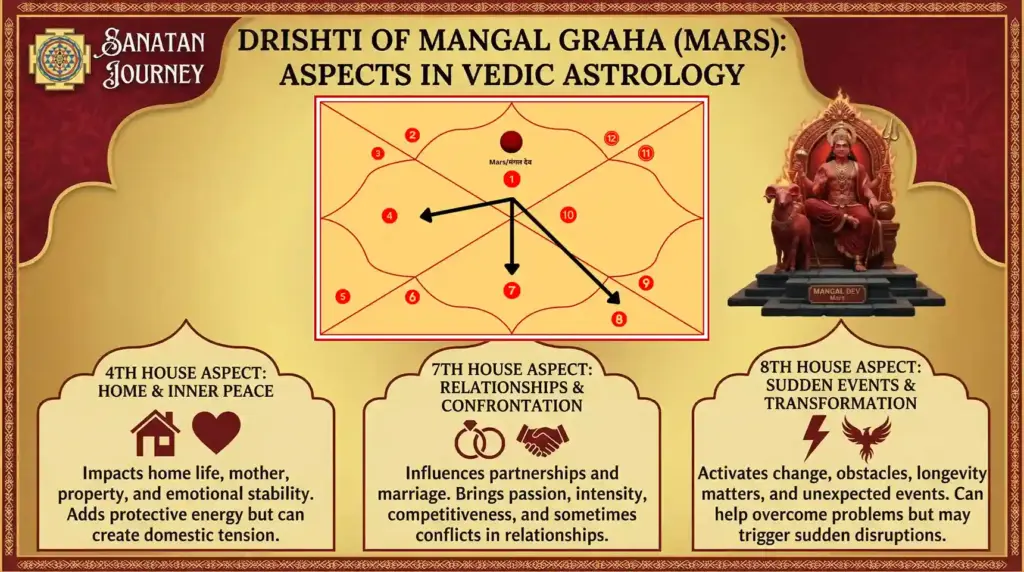
In Vedic astrology, planets “look” at other houses to influence them. This “look” is called “Drishti” or Aspect.
Most planets only look at the house directly opposite to them (the 7th house). But Mars is special. It has extra “special aspects” that make it very powerful.
According to the rules in BPHS, Mars casts a full aspect on three specific places from where it sits:
The 7th House Aspect (Direct Opposition)
Like all other planets, Mars looks at the 7th house from itself.
What it means: This aspect represents direct confrontation and relationships. Mars sends its fiery energy to the opposite house, which can bring passion but also arguments to your partnerships.
The 4th House Aspect (Square)
Mars also looks at the 4th house from its position.
What it means: The 4th house represents your home, mother, and inner peace. When Mars looks here, it brings its protective but aggressive energy to your home life. It wants to defend and secure your personal space.
The 8th House Aspect (Transformation)
This is a very unique aspect. Mars looks at the 8th house from itself.
What it means: The 8th house is about sudden changes, longevity, and obstacles. Mars’s aspect here is like a laser beam that triggers sudden events or transformations. It can destroy problems, but it can also cause sudden accidents or surgeries if not well-placed.
So, if Mars is sitting in your 1st house (Ascendant), it will influence:
- The 4th house (Your home and happiness)
- The 7th house (Your marriage and partners)
- The 8th house (Sudden events and longevity)
Understanding these aspects helps you see where Mars is directing its energy in your life. Is it protecting your home? Challenging your relationships? Or triggering a big change? By checking these three places, you can get a full picture of Mars’s impact.
Planetary Relationships of Mars
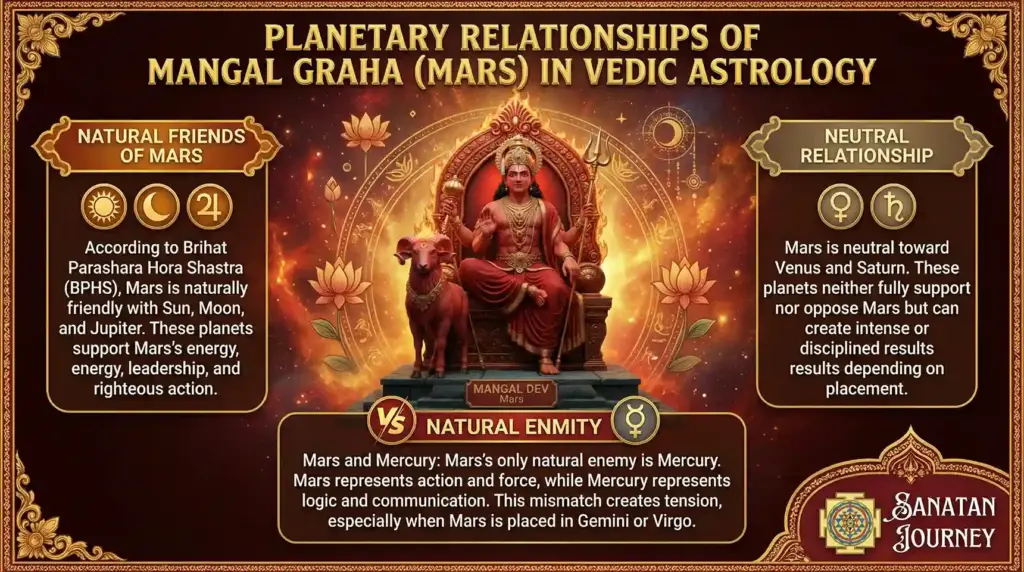
Just like you have friends who support you and rivals who challenge you, Mars has specific relationships with other planets.
In Vedic astrology, these relationships are crucial because they determine how Mars behaves in your chart. A planet is comfortable and productive in a friend’s house but struggles in an enemy’s territory.
According to the Brihat Parashara Hora Shastra, planetary relationships are divided into three categories: Natural (Naisargika), Temporary (Tatkalika), and Compound (Panchadha) relationships.
Here, we will focus on the Natural Relationships of Mars to help you understand its permanent friends and foes.
Friendly Planets
Mars is a fiery, action-oriented planet. Naturally, it gets along best with planets that share its drive or wisdom.
According to BPHS, Mars’s natural friends are Sun, Moon, and Jupiter.
Sun and Mars: Think of the Sun as the King and Mars as the Commander-in-Chief. They work perfectly together.
The Sun provides the vision and authority, while Mars provides the energy to execute orders. When Mars is in the Sun’s sign (Leo), it feels energized and ready to lead.
Moon and Mars: The Moon represents the mind and emotions. When Mars (energy) partners with the Moon, it creates a “wealth-generating” combination (often called Chandra-Mangala Yoga).
The Moon acts like a nurturing mother who guides the energetic child (Mars) to use its strength constructively.
Jupiter and Mars: Jupiter is the wise teacher (Guru). Mars respects wisdom and guidance. When Mars is with Jupiter or in Jupiter’s signs (Sagittarius or Pisces), its aggressive energy becomes disciplined and focused on righteous causes. It’s like a warrior fighting for a higher purpose.
Enemy Planet
Mars is direct and aggressive, so it clashes with planets that are too slow, diplomatic, or complex for its liking.
Mars’s natural enemy is Mercury.
Mercury vs. Mars: Mercury is the planet of intellect, communication, and diplomacy. It relies on words and logic. Mars, on the other hand, believes in action and force.
The Clash: Imagine a soldier (Mars) trying to solve a problem with a weapon, while a diplomat (Mercury) tries to solve it with a debate. They fundamentally misunderstand each other. Mars finds Mercury’s endless talking frustrating and indecisive.
Impact: If Mars is in Mercury’s signs (Gemini or Virgo), it feels uncomfortable. The warrior feels trapped in a library, forced to use words instead of muscles. This can lead to frustration, argumentative speech, or nervous energy.
Neutral Planets
Some planets neither fully support Mars nor completely oppose it. They have a working relationship based on mutual tolerance.
Mars is neutral toward Venus and Saturn.
Venus and Mars: Venus is about love, harmony, and pleasure. Mars is about passion and conquest. While they are different (Venus wants peace, Mars wants victory), they can coexist. Their combination often fuels intense passion and relationship dynamics, but they don’t share a deep, natural friendship or enmity.
Saturn and Mars: This is an interesting one. Saturn is cold, slow, and disciplined, while Mars is hot, fast, and impulsive. You might think they are enemies (and they often act like it when together!), but BPHS classifies Saturn as neutral to Mars.
Why? Because both are “malefic” planets that deal with harsh realities. They share a certain toughness. Mars respects Saturn’s ability to endure, even if Saturn’s slowness annoys Mars.
Dignity and Strength of Mars
How strong is the warrior in your chart? Just as a soldier performs differently on a battlefield versus a holiday resort, Mars behaves differently depending on which zodiac sign it occupies. In Vedic astrology, this “mood” or strength of a planet is called its dignity.
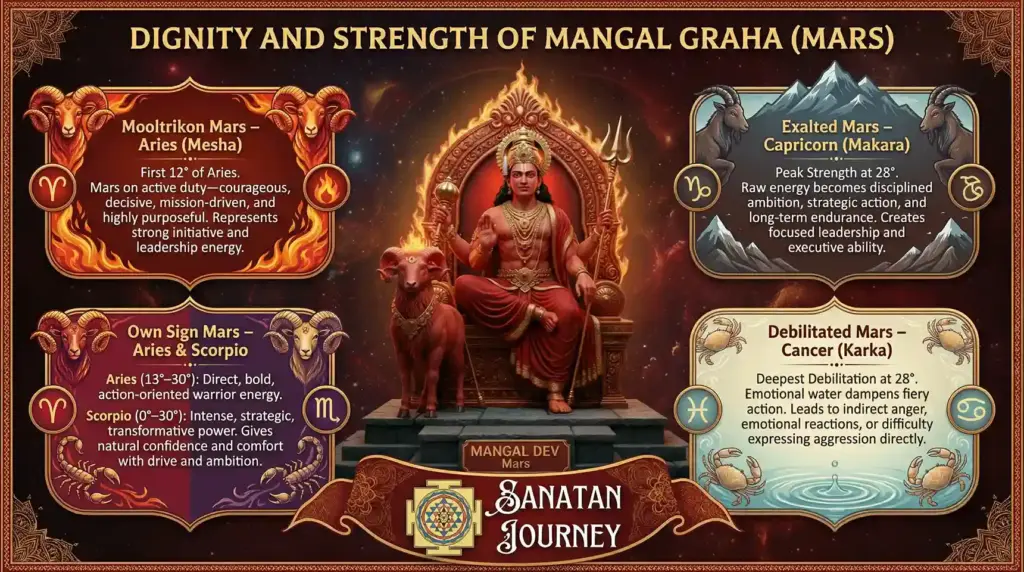
The Brihat Parashara Hora Shastra (BPHS) outlines specific signs where Mars feels powerful, happy, or uncomfortable.
Knowing these positions helps you understand the quality of energy you have at your disposal. Is your Mars a disciplined general, a wild rebel, or a frustrated fighter? Let’s find out.
Exaltation (Uchcha)
When a planet is exalted, it is in its “highest” state. It’s like a guest of honor at a grand party—excited, powerful, and ready to give its best results.
Sign: Mars is exalted in Capricorn (Makara).
Deep Exaltation Degree: The peak of this power is at 28 degrees of Capricorn.
Why Capricorn? Mars is a fiery planet of action. Capricorn is an earth sign ruled by Saturn, representing structure, discipline, and hard work.
When Mars enters Capricorn, its raw energy gets channeled into productive, disciplined ambition. It’s no longer just “fighting for the sake of fighting”; it’s fighting to build an empire.
Results: If you have an exalted Mars, you likely possess focused energy, executive ability, and the endurance to achieve long-term goals.
Debilitation (Neecha)
Debilitation is the opposite of exaltation. It’s like being stuck at a party you hate—uncomfortable, restricted, and unable to be yourself.
Sign: Mars is debilitated in Cancer (Karka).
Deep Debilitation Degree: The lowest point of this energy is at 28 degrees of Cancer.
Why Cancer? Cancer is a watery, emotional sign ruled by the Moon. It represents home, comfort, and sensitivity. Mars, the warrior, feels out of place here.
You can’t fight a war in a cozy living room! The fire of Mars gets dampened by the water of Cancer, often leading to passive-aggressiveness or emotional outbursts rather than direct action.
Results: A debilitated Mars doesn’t mean “weak” forever, but it often indicates a struggle to express anger directly. You might bottle things up until you explode, or you might fight battles on an emotional level rather than a practical one.
Mooltrikona
Mooltrikon is a planet’s “office.” It’s where the planet is busy performing its official duty. It is a very strong and comfortable position, second only to exaltation.
Sign: Mars’s Mooltrikon sign is Aries (Mesha).
Degrees: Specifically, the first 12 degrees of Aries are the Mooltrikon zone.
Why Aries? Aries is a fire sign ruled by Mars. It is the first sign of the zodiac, representing new beginnings and identity. Here, Mars is on “active duty,” executing its role as the commander. It is sharp, decisive, and ready to lead.
Results: A Mars in Mooltrikon gives you a strong sense of purpose. You are duty-bound, courageous, and efficient in your actions. You don’t just have energy; you have a mission.
Swarashi (Own Sign)
Swarashi means “own sign.” This is like being in your own home. You are relaxed, natural, and completely comfortable.
Signs: Mars owns two signs: Aries and Scorpio.
Degrees:
In Aries: From 13 to 30 degrees counts as Own Sign (since the first 12 degrees are Mooltrikon).
In Scorpio: The entire sign (0 to 30 degrees) is Mars’s own territory.
Why These Signs?
Aries (Fire): Here, Mars is the extroverted warrior—direct, physical, and visible. It’s the “daytime” energy of Mars.
Scorpio (Water): Here, Mars is the introverted strategist. Scorpio is a secretive, fixed water sign. Mars in Scorpio is intense, researching, and transformative. It’s the “nighttime” energy of Mars—less about open combat and more about hidden power and psychological strength.
Results: Having Mars in its own sign gives you a natural confidence. You are comfortable with your aggression and drive. In Aries, you are a pioneer; in Scorpio, you are a detective or a healer.
States (Avastha) of Mars
Just like you feel different when you are tired versus when you are energized, planets also have “states” or Avasthas that change their mood and behavior.
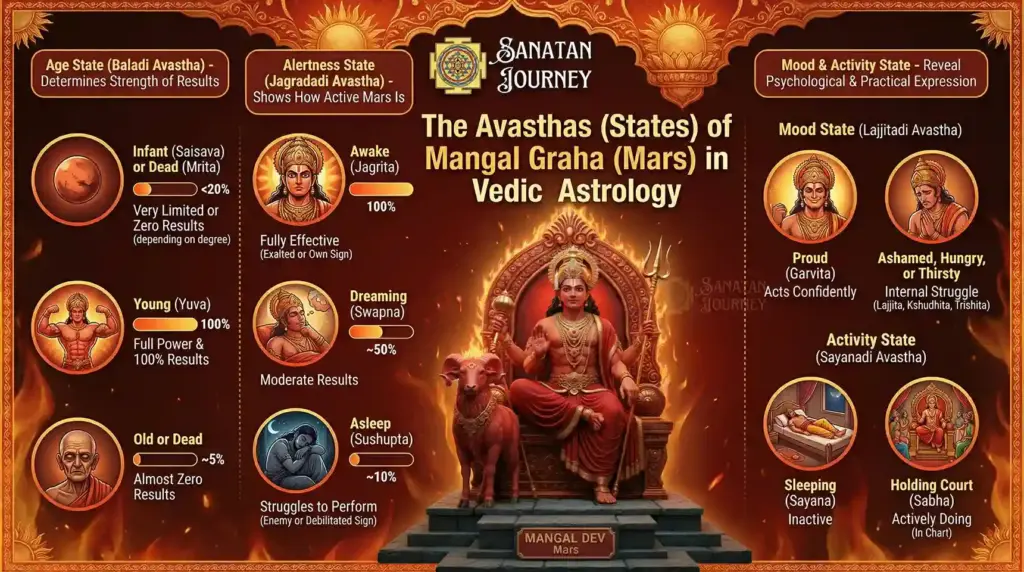
It’s not enough to just say “Mars is in Aries.” We need to know: Is Mars a wide-awake soldier ready for battle, or is he a sleepy commander napping in his tent?
The Brihat Parashara Hora Shastra breaks down these states into detailed categories. Understanding the specific state of Mars in your chart reveals the quality of your energy—whether it’s productive, destructive, or simply dormant.
Let’s explore the key Avasthas of Mars according to this ancient text.
Age-Related State (Baladi Avasthas)
Planets, like humans, go through stages of life—from childhood to old age. The “age” of Mars depends on the degree it occupies in a sign. A “young” Mars has different energy than an “old” Mars.
- Infant (Saisava): If Mars is in the very early degrees of an odd sign (0°-6°) or late degrees of an even sign (24°-30°), it is like an infant. Its energy is potential but not fully developed. It gives about 25% of its results.
- Adolescent (Kumara): In the next phase (6°-12° in odd signs, 18°-24° in even signs), Mars is a teenager. It’s energetic and learning but maybe a bit reckless. It gives 50% results.
- Youth (Yuva): This is the prime state (12°-18° in both signs). A “Young” Mars is like a warrior in his prime—strong, capable, and fully effective. It delivers 100% of its results.
- Old (Vriddha): As Mars advances (18°-24° in odd signs, 6°-12° in even signs), it becomes “Old.” It has experience but lacks physical vitality. It gives only some results.
- Dead (Mrita): In the final degrees (24°-30° in odd signs, 0°-6° in even signs), Mars is “Dead.” Its energy is extremely low, giving almost zero results.
Tip: Check your Mars degree! A Mars at 15° (Youth) is a powerhouse, while a Mars at 29° (Dead) might struggle to get things done.
Alertness-Related State (Jagradadi Avasthas)
- This state tells us how “awake” or conscious Mars is. This is crucial for understanding if Mars can actually deliver what it promises.
Awake (Jagrita): When Mars is in its Exaltation (Capricorn) or Own Sign (Aries, Scorpio), it is fully awake. It is alert, sharp, and ready to act. This is the best state for success. - Dreaming (Swapna): When Mars is in a Friendly or Neutral sign (like Leo, Sagittarius, Pisces, Aquarius), it is “dreaming.” It’s not fully focused but still reasonably effective. It gives medium results.
- Asleep (Sushupta): When Mars is in an Enemy’s sign (like Gemini or Virgo) or Debilitated (Cancer), it is “asleep.” A sleeping guard can’t protect the fort. In this state, Mars gives negligible or confusing results.
Attitude and Mood State (Lajjitadi Avasthas)
- These states describe the complex emotional mood of Mars based on who it is hanging out with. It adds a psychological layer to your chart.
Proud (Garvita): If Mars is in its Exaltation or Mooltrikon sign, it feels proud and confident. It knows its worth and acts with authority. - Ashamed (Lajjita): If Mars is in the 5th house specifically with the Sun, Saturn, or Rahu/Ketu, it feels “ashamed.” This is a tricky state where your drive might be clouded by guilt or lack of confidence.
- Hungry (Kshudhita): If Mars is in an enemy’s sign or aspected by an enemy (like Mercury), it feels “starving.” It’s desperate for energy but can’t find satisfaction, often leading to frustration.
- Thirsty (Trishita): If Mars is in a watery sign (Cancer, Scorpio, Pisces) and aspected by enemies without any help from benefics, it becomes “thirsty.” This can manifest as an unquenchable desire or emotional neediness.
Activity State (Sayanadi Avasthas)
This is the most detailed “activity” check. It requires a calculation (using the planet’s position, the birth star, and time) to find out exactly what Mars is doing.
There are 12 specific activities, such as Eating, Sleeping, Walking, or Holding a Court.
While we can’t calculate your specific state without your birth details, here are a few possibilities mentioned in BPHS for Mars:
- Sayana (Sleeping): Mars might be resting. If it is, it could mean low energy or a need for rest before action.
- Bhojana (Eating): Mars is nourishing itself. This usually indicates enjoying the fruits of your labor or being distress if Mars is weak.
- Gamana (Walking/Moving): Mars is on the move. This often brings travel, restlessness, or a constantly active lifestyle.
- Sabha (Holding Court): Mars is in a royal assembly. This suggests high status, leadership, and recognition.
Why does this matter?
A “Young, Awake, and Proud” Mars will make you a high-achiever. An “Infant, Asleep, and Ashamed” Mars might mean you have great ideas but struggle to take the first step.
By analyzing these states, you move beyond generic horoscopes and understand the unique blueprint of your energy.
Frequently Asked Questions
Why is Mars called the “Commander-in-Chief”?
In the planetary cabinet, Mars acts as the soldier and leader of the army. He represents the strength and discipline you need to take action, protect others, and lead projects to success.
What does it mean if Mars is “Exalted”?
Mars is “Exalted” when he sits in the sign of Capricorn. In this position, he reaches his highest power and behaves like a very wise, disciplined warrior who helps you achieve big goals.
Who are the best friends of Mars?
According to the Brihat Parashar Hora Shastra, Mars is naturally friendly with the Sun, Moon, and Jupiter. When he is with them, his energy becomes very positive and helpful for you.
What is Kuja Dosha (Manglik Dosha)?
This happens when Mars sits in specific houses like the 1st, 4th, 7th, 8th, or 12th. It means his fiery energy might cause some arguments in relationships, but many people have this, and it has simple remedies.
Which body parts does Mars rule?
Mars governs your muscles, bone marrow, and blood. He is the planet that gives you physical strength, stamina, and the ability to stay active and healthy.
What does it mean when Mars is “Debilitated”?
Mars is “Debilitated” in the sign of Cancer. In this spot, he feels weak and unhappy, which might make a person feel a bit moody or less confident about taking bold steps.
How does Mars help in your career?
Because Mars loves technical work and land, he often helps people become successful engineers, builders, surgeons, or soldiers. He gives you the focus and “can-do” attitude needed for these jobs.