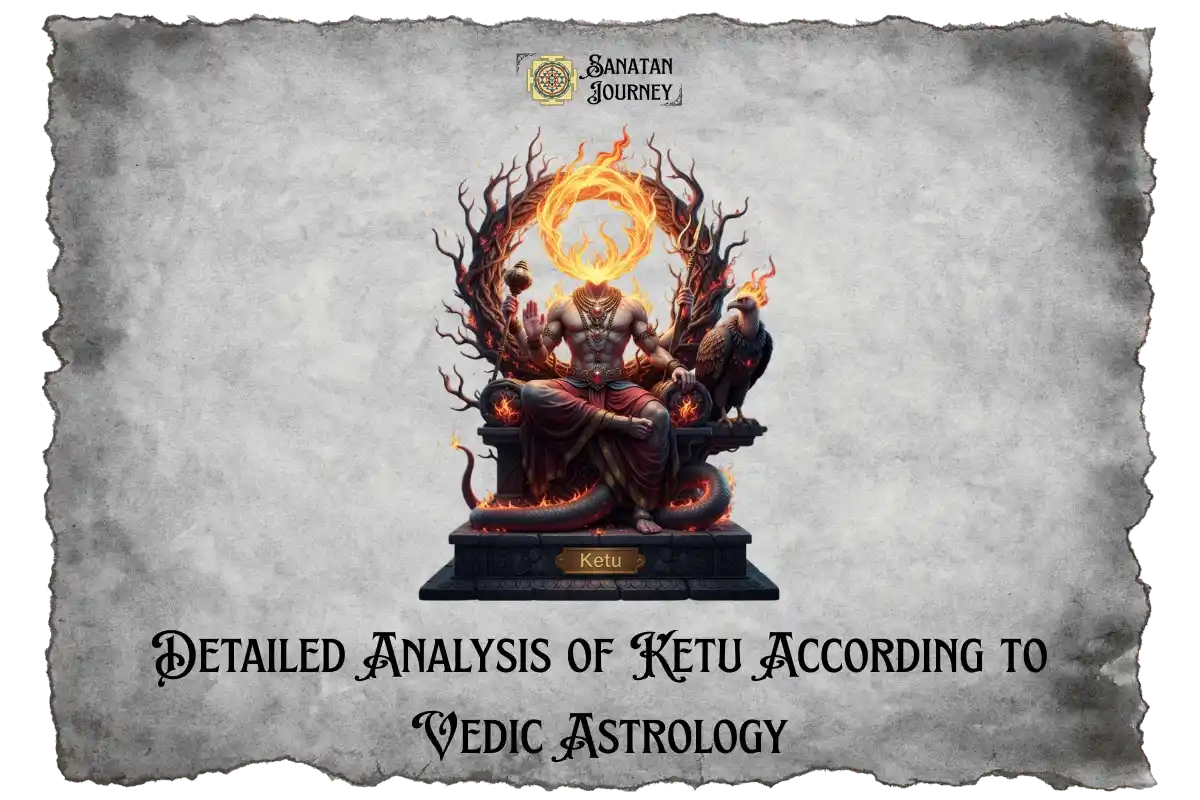

Have you ever wondered why some things in your life suddenly disappear or change without warning? In Vedic astrology, Ketu plays a big role in these mysterious events.
This shadow planet represents detachment, spiritual growth, and past-life karma. You’ll discover how Ketu shapes your spiritual journey and life experiences in ways you never imagined.
Think of Ketu as that friend who always pushes you toward something bigger than yourself. While Rahu makes you crave material things, Ketu does the opposite—it helps you let go.
According to Brihat Parashara Hora Shastra (BPHS), this celestial body isn’t just any planet. It’s a mathematical point where the Moon’s orbit crosses the Sun’s path, creating what we call the South Node.
Tattva (Element) of Ketu
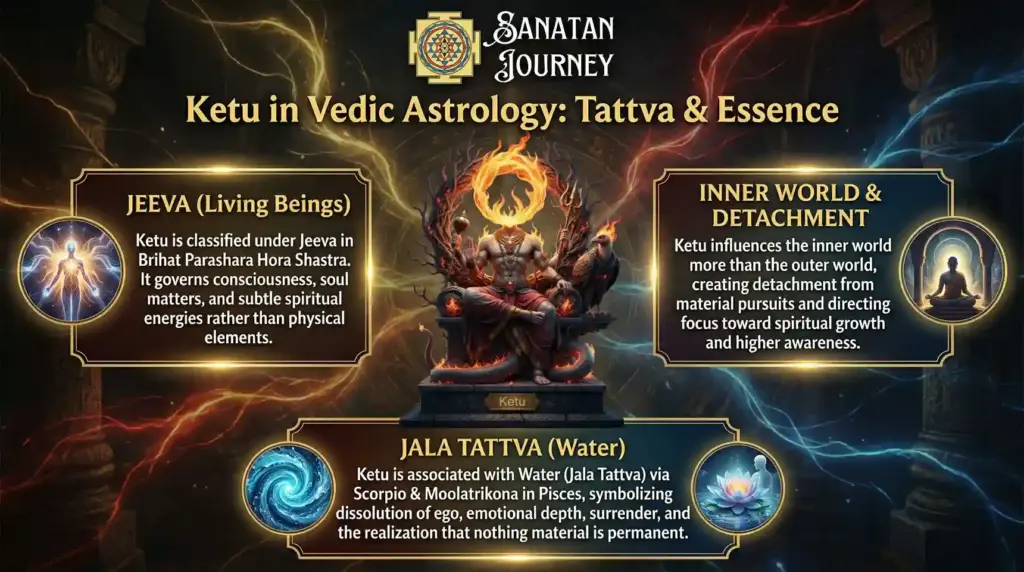
You might be curious about which element rules Ketu. According to Brihat Parashara Hora Shastra, the classification of planets into the five elements (Pancha Mahabhuta) includes Fire, Earth, Air, Water, and Space.
However, Parasara assigns these elements only to the seven physical planets, not to Rahu and Ketu.
But here’s where it gets interesting. BPHS classifies planets into three categories:
Dhatu (metals/materials), Moola (roots/vegetables), and Jeeva (living beings).
Guess what? Ketu falls under the Jeeva category, along with Mercury and Jupiter. This classification tells you something important—Ketu deals with consciousness, soul matters, and subtle energies rather than gross material substances.
What does this mean for you? When a planet rules Jeeva, it affects your spiritual consciousness and living essence.
You’ll notice Ketu’s influence more in your inner world than in physical, material things. That’s why people with strong Ketu often feel disconnected from material pursuits.
The element association becomes clearer when you look at Ketu’s sign ownership. According to Vedic astrology texts, Ketu owns Scorpio and has its Moolatrikona in Pisces.
Both these signs belong to the Jala tattva (Water element). Water represents dissolution, depth, emotions, and the ability to merge and let go.
Think about water for a moment. It takes the shape of any container you pour it into. It can be calm like a pond or powerful like an ocean.
Similarly, Ketu in water signs shows your ability to dissolve ego boundaries and merge with higher consciousness. Water also flows downward, just like Ketu’s energy moves you toward humility and surrender.
The connection with water explains why Ketu creates a sense of flowing away from material attachments. You can’t hold water tightly in your fists—it slips through your fingers.
That’s exactly how Ketu works in your life. It makes you realize you can’t hold onto anything permanently in this material world.
Nature of Ketu
Is Ketu your friend or enemy? Let’s clear this up right now. According to Brihat Parashara Hora Shastra, Ketu is a natural malefic (Krura Graha). Parasara clearly lists Sun, Mars, Saturn, Rahu, and Ketu as malefic planets.
But wait—don’t panic! Being a malefic doesn’t mean Ketu will only bring bad things into your life. You need to understand what “malefic” actually means in Vedic astrology.
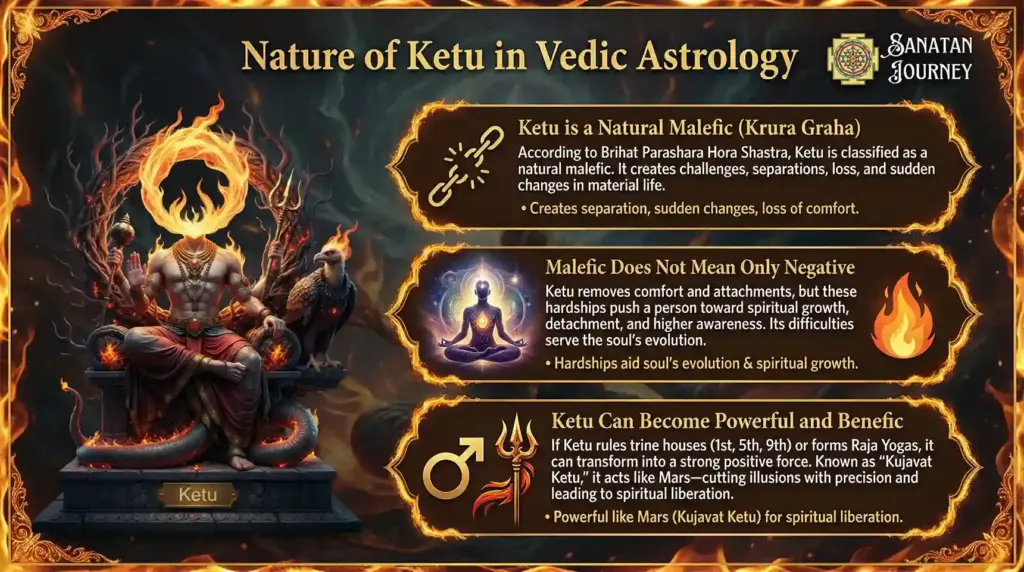
A malefic planet creates challenges, separations, and difficulties in material matters. However, these same challenges push you toward spiritual growth and enlightenment.
Here’s a simple way to think about it: Imagine a strict teacher who gives you tough homework. You might not like the homework, but it makes you smarter.
That’s Ketu for you. It removes comfort and ease from certain life areas, but this removal serves a higher purpose—your soul’s evolution.
Why does Parasara call Ketu a malefic? Because it naturally causes loss, detachment, and sudden changes. You can’t predict when Ketu will strike.
One day everything seems fine, and the next day, something significant changes in your life. This unpredictability makes people uncomfortable.
However, there’s a beautiful twist in Vedic astrology. Any planet, even a natural malefic, can become a functional benefic depending on which houses it rules in your specific birth chart.
If Ketu rules your trine houses (1st, 5th, or 9th) or gets involved in Raja Yogas (combinations for success), it transforms into a powerful force for good.
Think about great spiritual masters and renunciates. Many of them have prominent Ketu in their charts. The same malefic energy that creates material loss for one person creates spiritual abundance for another. It all depends on your chart’s overall structure and your life’s purpose.
The ancient text also mentions that Ketu behaves like Mars (this concept is called “Kujavat Ketu”). Mars is also a malefic, but it’s the planet of courage, action, and warrior energy.
So Ketu combines malefic sharpness with a cutting, surgical precision. It cuts away illusions and false attachments, just like a surgeon removes a tumor to save your life.
When you experience Ketu’s malefic nature, you’re actually experiencing a spiritual surgery. Yes, it hurts. Yes, you lose things. But what you gain is freedom from bondage and a clearer vision of reality.
Karakatva of Ketu
You might be wondering, “What exactly does Ketu handle in my life?” In Vedic astrology, every planet has a portfolio, or a list of things it is responsible for.
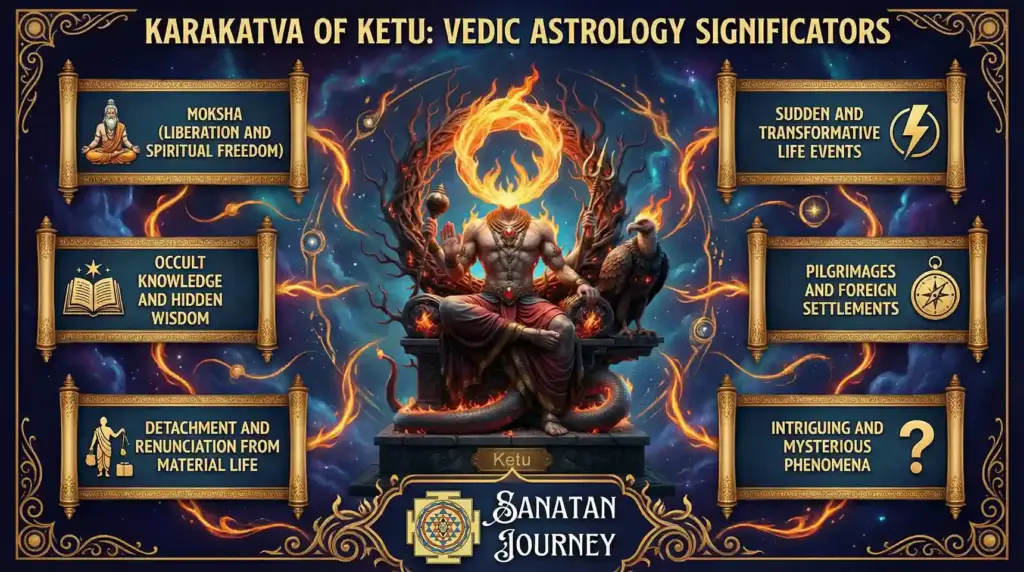
These are called Karakatvas (significations). While other planets might give you cars, money, or fame, Ketu’s list is quite unique—it deals with things that are hidden, spiritual, and transformative.
According to Brihat Parashara Hora Shastra and the insights from the attached text, Ketu is the master of endings and new beginnings that don’t make sense to the logical mind. It governs the things you can’t touch but definitely feel.
Here is the list of Ketu’s main responsibilities in your chart:
Moksha (Final Liberation): This is Ketu’s biggest job. It is the Moksha Karaka, the planet that helps you break free from the cycle of birth and rebirth.
Occult Knowledge: If you love secrets, astrology, or mysteries, thank Ketu. It rules over hidden wisdom and the 8th house matters like deep research.
Pilgrimages and Foreign Trips: Ketu loves to wander. It signifies holy journeys and living in strange or foreign lands, often to find oneself.
Maternal Grandfather: Just as Rahu represents your paternal grandfather, Ketu represents your mother’s father (maternal grandfather).
Matsya Avatara: Among the incarnations of Lord Vishnu, Ketu is connected to the Matsya (Fish) Avatara, who saved the Vedas and knowledge from the great flood.
Detachment and Renunciation: Ketu gives you the power to say “no” to worldly pleasures. It is the force behind monks, ascetics, and anyone who walks away from material success.
Skin and Itching: On a physical level, Ketu can cause mysterious skin troubles, itching, or ailments that are hard to diagnose.
Ganesha: The deity associated with Ketu is Lord Ganesha, the remover of obstacles. Worshiping Ganesha helps calm Ketu’s intense energy.
Healing and Medicine: Because it acts like a surgeon, Ketu is also linked to doctors, healing arts, and natural medicine.
Sudden Events: Like a lightning bolt, Ketu brings sudden, unexpected changes—accidents or surprises—that shift your life’s direction completely.
Drishti of Ketu
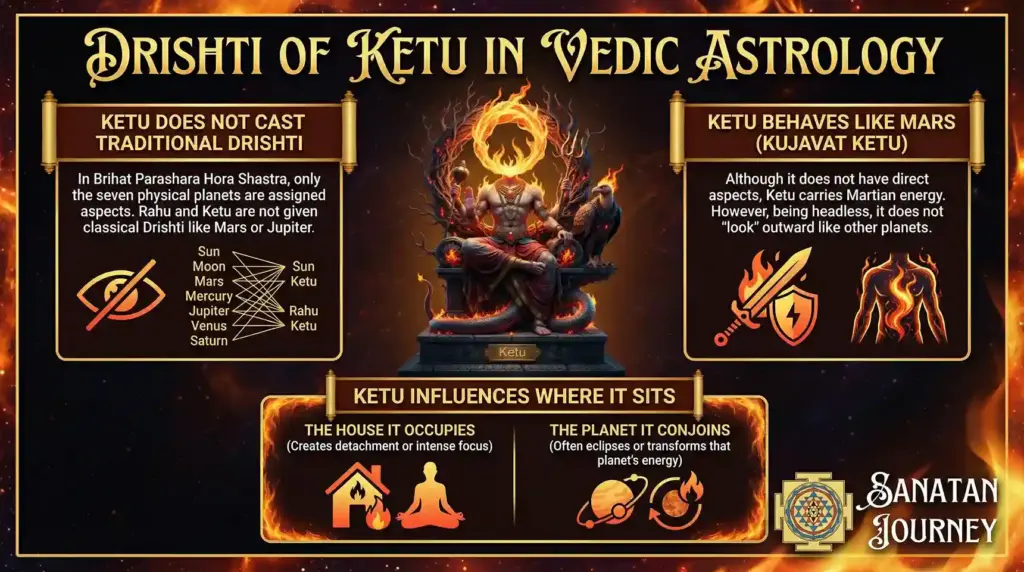
Now, let’s talk about Drishti, or how Ketu “looks” at other parts of your chart. This is a bit of a trick question in astrology!
If you open the main chapters on planetary aspects in Brihat Parashara Hora Shastra, the sage lists specific aspects for the seven physical planets (Sun through Saturn) but stays silent on Rahu and Ketu in the primary verses. This means, technically, Ketu does not cast a “Drishti” in the same way Jupiter or Mars does.
However, the text gives us a very important clue. It says: “Ketu behaves like Mars (Kujavat Ketu).”.
Since Ketu acts like Mars, many astrologers believe it carries some of Mars’s energy. But here is the catch: Ketu is headless. How can it “look” (Drishti) without eyes? Instead of looking outward, Ketu influences:
The House It Sits In: Ketu creates a “vacuum” or intense focus in the house it occupies.
The Planet It Sits With: It deeply affects any planet it shares a room (house) with, often eclipsing that planet’s energy.
So, when analyzing your chart, focus less on where Ketu is “looking” and more on where it is “sitting.” That is where the real spiritual surgery is happening!
Planetary Relationships of Ketu
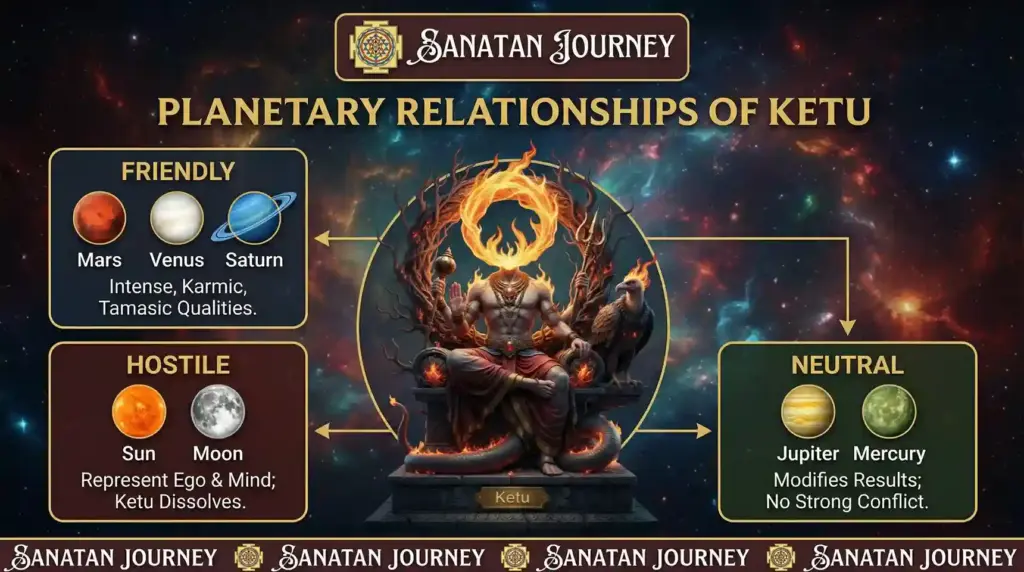
You might think that because Ketu is a “malefic” planet, it doesn’t like anyone. But that’s not true! Relationships in Vedic astrology are determined by the signs a planet rules and its natural qualities.
However, there is a catch: the classic text Brihat Parashara Hora Shastra gives explicit formulas for the seven physical planets but doesn’t list a standard “Friend/Enemy” table for Rahu and Ketu in the same way.
Because Ketu doesn’t own any signs in the standard scheme (though it co-rules Scorpio), astrologers use a specific rule to determine its relationships: Ketu reflects the nature of the lord of the sign it occupies.
However, based on its natural qualities and the consensus of Vedic texts, we can categorize its relationships as follows:
Friendly Planet
You will be surprised to know that Ketu finds its best friends in the planets that are usually considered “malefic” or “tamasic” by others.
Mars: Ketu acts like Mars (Kujavat Ketu). They share a fiery, aggressive, and cutting nature. Mars is the general, and Ketu is the flag of the army. When they come together, they create intense energy and drive.
Venus: While they seem different (Venus is luxury, Ketu is detachment), they are often considered friends in the context of their relationship codes. Venus rules the demons (Asuras), and Ketu is a demon’s tail.
Saturn: Saturn and Ketu are both planets of separation and karma. They understand each other’s language of suffering and detachment perfectly.
Enemy Planet
Ketu is a node of the Moon, created when the demon Swarbhanu was beheaded by Lord Vishnu. Naturally, its biggest enemies are the luminaries who exposed him.
Sun: The Sun represents the soul and ego, while Ketu represents the dissolution of ego. They are natural enemies. Ketu eclipses the Sun, trying to swallow the light of the self to lead you to spiritual liberation.
Moon: The Moon represents the mind and emotions. Ketu causes the mind to feel detached, anxious, or isolated. This is why a Moon-Ketu conjunction is often difficult for emotional stability, as they are bitter enemies.
Neutral Planet
There are planets that Ketu neither loves nor hates. It simply co-exists with them, often modifying their results without intense conflict.
Jupiter: Jupiter is the great benefic and the teacher (Guru). Ketu is the spiritual seeker (Moksha Karaka). While they are technically neutral, their combination is powerful for spirituality (Ganesha Yoga). Jupiter can guide Ketu’s chaotic energy into wisdom.
Mercury: Mercury is the intellect. Ketu is intuition. They function on different planes—one is logical, the other is mystical. They maintain a neutral relationship, neither helping nor harming each other excessively.
Dignity and Strength of Ketu
You might think that because Ketu is a “headless” shadow planet, it doesn’t follow the rules of strength like the Sun or Moon. But that’s not true!
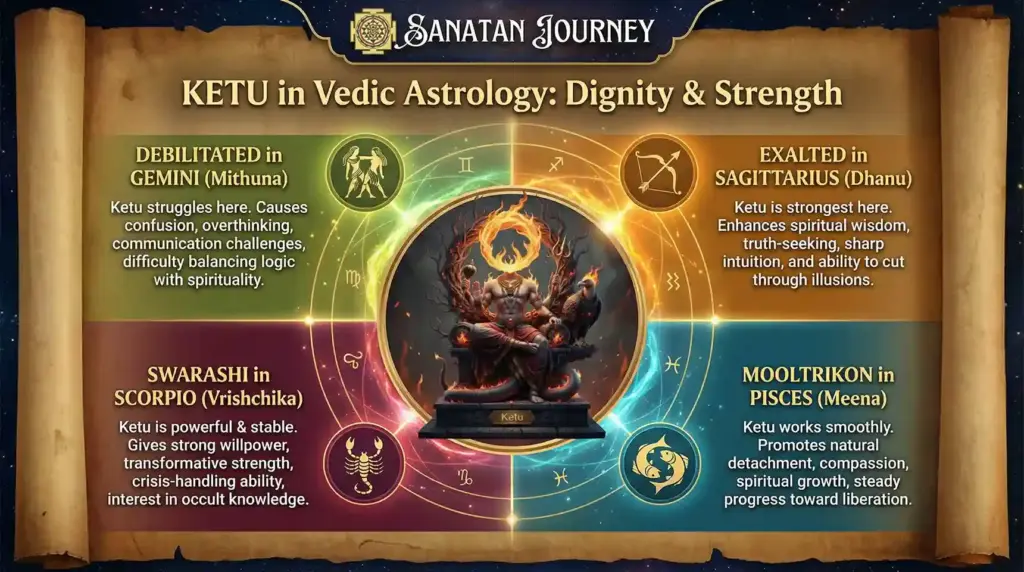
In fact, the ancient sage Parasara gives very specific details about where Ketu is strong. Understanding this can explain why some people have amazing spiritual insight while others feel confused and lost.
In the Brihat Parashara Hora Shastra, we find clear guidelines on Ketu’s favorite signs. Let’s break down the four main states of dignity: Exaltation (Uchcha), Debilitation (Neecha), Mooltrikon, and Swarashi (Own Sign).
Exaltation
Have you ever felt like you’re on top of the world? That’s how a planet feels when it is exalted. For Ketu, this special place is the sign of Sagittarius (Dhanu). Some texts also mention Scorpio, but for our main reference here, Sagittarius is the key.
Why Sagittarius? Well, Sagittarius is a fire sign ruled by Jupiter, the planet of wisdom. It represents higher learning, philosophy, and seeking the truth.
Since Ketu is the planet of moksha (liberation), it loves being here! When Ketu is exalted in your chart, it acts like a super-charged spiritual antenna. You might find yourself naturally drawn to deep questions about life, God, and the universe.
An exalted Ketu gives you the power to cut through illusions. It makes you fearless in your pursuit of truth.
Instead of being confused, your intuition becomes sharp and accurate. You might even have a knack for research or digging up hidden information.
So, if you see Ketu in Sagittarius in your birth chart, don’t worry about it being a “malefic.” Here, it’s on a mission to make you wise and free.
Debilitation
Now, let’s look at the opposite. What happens when a planet is in a place it hates? This is called Debilitation. For Ketu, the sign of Gemini (Mithuna) is its weakest spot.
Think about it. Gemini is an air sign ruled by Mercury. It’s all about chatting, social networking, logic, and gathering facts.
Ketu, on the other hand, is about silence, isolation, and intuition. It’s like a monk at a loud cocktail party—totally out of place!
When Ketu is debilitated in Gemini, it can create confusion. You might struggle to express yourself clearly or feel misunderstood.
Your mind might race with too many thoughts, making it hard to focus. Instead of deep wisdom, you might get caught up in superficial gossip or overthinking.
But here’s a secret: Even a debilitated planet can teach you something. A weak Ketu forces you to learn how to communicate your inner feelings.
It challenges you to balance your logical mind with your spiritual heart. It’s not “bad”—it’s just a harder lesson to learn.
Mooltrikona
This is a fancy word for a planet’s “office.” It’s where the planet is very comfortable and gets its job done efficiently. For Ketu, its Mooltrikon sign is Pisces (Meena).
Pisces is the 12th sign of the zodiac, representing the ocean, dreams, and the final exit from this world. Since Ketu is the Moksha Karaka (significator of liberation), Pisces is the perfect office for it! Here, Ketu is happy doing exactly what it was born to do: helping you let go of attachments.
In this sign, Ketu works smoothly. It gives you a natural sense of detachment. You might not care as much about money or fame as others do. You might be very charitable or interested in helping those who are suffering.
Having Ketu in Pisces is a blessing for spiritual progress. It doesn’t bring the intense fire of exaltation, but it brings a steady, peaceful flow toward enlightenment. It’s like having a job you love—you do it well without even trying.
Swarashi
Finally, let’s talk about Swarashi, which means “Own Sign.” This is like a planet’s own home. You can relax, be yourself, and no one tells you what to do. For Ketu, the sign of Scorpio (Vrishchika) is its home.
Wait, isn’t Mars the ruler of Scorpio? Yes! But in Vedic astrology, Ketu is often called the co-ruler of Scorpio. This water sign is deep, mysterious, and intense—just like Ketu.
When Ketu is in Scorpio, it is strong and stable. It gives you immense willpower and the ability to handle crises.
You become like a phoenix that can rise from the ashes. You might have a strong interest in the occult, psychology, or healing.
In its own sign, Ketu protects you. It gives you the courage to face your inner demons and transform yourself. You aren’t afraid of the dark because you know that’s where the real treasure is hidden.
States (Avasthas) of Ketu
You might think a planet is either “good” or “bad,” but it’s not that simple. A strong planet might be “asleep,” while a weak one might be “awake.” Understanding these states gives you the real picture of how Ketu operates in your life.
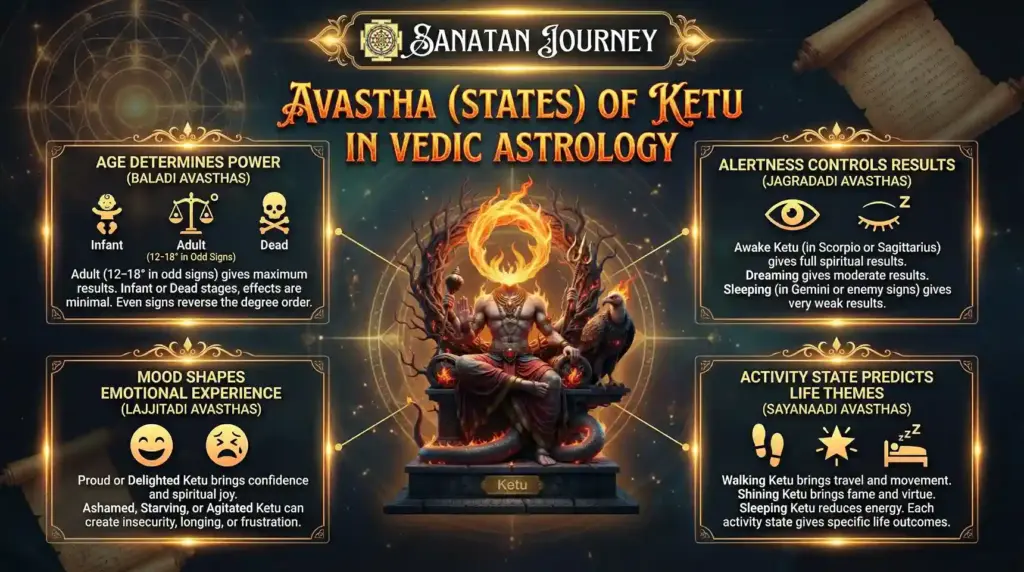
According to the classic texts, there are several ways to check a planet’s state. We look at its age (is it a baby or an adult?), its alertness (is it sleeping or working?), its mood (is it happy or sad?), and its activity level. Let’s break these down one by one.
Age-Related State (Baladi Avasthas)
First up is the Age-Related State, known as Baladi Avasthas. Imagine Ketu growing up from a baby to an old person as it moves through a zodiac sign.
In odd signs (like Aries, Gemini, Leo), the order goes like this:
- 0-6 degrees: Infant (Bal) – Just like a baby, the planet has low energy and gives very little result.
- 6-12 degrees: Youth (Kumara) – It’s like a playful teenager, giving about half its potential results.
- 12-18 degrees: Adult (Yuva) – This is the prime time! Ketu here is fully grown, strong, and gives maximum results.
- 18-24 degrees: Old (Vriddha) – Like an elderly person, the energy is fading, giving only a little result.
- 24-30 degrees: Dead (Mrita) – Here, the planet has almost no energy left to act.
In even signs (like Taurus, Cancer, Virgo), the order reverses! So, 0-6 degrees is Dead (Mrita), and 24-30 degrees is Infant (Bal).
So, if your Ketu is in the “Adult” state, watch out! Its effects—whether spiritual detachment or sudden changes—will be very strong and noticeable. But if it’s “Infant” or “Dead,” you might barely feel its impact in that area of your life.
Alertness-Related State (Jagradadi Avasthas)
Next, let’s check if Ketu is awake or hitting the snooze button. This is called the Alertness-Related State or Jagradadi Avasthas.
It’s pretty simple:
- Awake (Jagrat): If Ketu is in its own sign (Scorpio) or exalted sign (Sagittarius), it is wide awake! An awake Ketu is fully alert and ready to do its job of spiritual awakening and removing obstacles. It gives full results.
- Dreaming (Swapna): If Ketu is in a friend’s sign or a neutral sign, it’s in a dream state. It’s somewhat active but maybe a bit distracted. It gives medium results—like listening to music while doing homework.
- Sleeping (Sushupta): If Ketu is in an enemy’s sign or debilitated (Gemini), it is fast asleep. A sleeping planet can’t really help you much. It’s practically inactive.
Think of it this way: An awake Ketu is a powerful spiritual guide. A sleeping Ketu is like having a guide who’s taking a nap when you need directions!
Attitude and Mood State (Lajjitadi Avasthas)
Now things get emotional. Planets have feelings too! This set of states, called Lajjitadi Avasthas, tells us about Ketu’s mood based on who it’s sitting with.
- Ashamed (Lajjita): If Ketu is with the Sun, Mars, or Saturn in the 5th house, it feels shy or ashamed. This might make you feel insecure about your intelligence or children.
- Proud (Garvita): If Ketu is in its exaltation sign or Mooltrikon (Pisces), it feels proud and confident. A proud Ketu gives you strong self-belief in your spiritual path.
- Starving (Kshudhita): If Ketu is in an enemy’s sign, seeing an enemy, or with Saturn, it feels hungry and unsatisfied. This can create a deep sense of longing or emotional pain.
- Thirsty (Trishita): If Ketu is in a water sign and looked at by evil planets, it feels thirsty. This implies a desire that isn’t being met.
- Delighted (Mudita): If Ketu is in a friend’s sign or with a friendly planet like Jupiter, it is happy! A happy Ketu brings joy through spirituality and detachment.
- Agitated (Kshobhita): If Ketu is with the Sun and looked at by enemies, it gets angry and agitated. This can lead to frustration and sudden outbursts.
Knowing Ketu’s mood helps you understand why you might feel a certain way. Is your detachment coming from a place of peace (Delighted) or pain (Starving)?
Activity State (Sayanaadi Avasthas)
Finally, we have the Activity State or Sayanaadi Avasthas. This is a bit more complex calculation involving nakshatras (stars) and other factors, but it basically tells us what Ketu is doing at the moment of your birth.
Is it eating (Bhojana)? Walking (Gamana)? Sleeping (Sayana)? Or maybe holding a court (Sabha)?
For example:
- Sayana (Sleeping): If Ketu is in this state, it might make you lazy or prone to digestive issues.
- Upavesana (Sitting): This is great for stability but can be bad for health if afflicted.
- Prakasana (Shining): This state brings fame and virtue. A shining Ketu makes you a beacon of spiritual light.
- Gamana (Walking): This indicates lots of travel and moving around, which fits Ketu’s wandering nature perfectly.
These states give us very specific predictions. A “Walking” Ketu might make you a globetrotter, while a “Sleeping” Ketu might make you prefer staying at home in your own world.
Frequently Asked Questions
Is Ketu a real planet like the Earth or Mars?
No, it is a “shadow planet” or Chaya Graha. It does not have a physical body made of rocks or gas. Instead, it is a mathematical point in space where the paths of the Sun and Moon cross, creating a powerful energy spot.
Why is Ketu called the “tail of the dragon”?
In ancient stories, a giant dragon was cut into two pieces. The head became Rahu, and the body and tail became Ketu. Because it has no head, it does not use a logical brain; it uses its heart and intuition to guide you.
Does Ketu always bring bad luck?
Not at all! While it is a “malefic” planet that can cause sudden changes or losses, it does this to help you grow. Its main goal is to free you from being too attached to toys or money so you can find real, lasting happiness inside yourself.
What is the “Moksha Karaka”?
This is a special title for Ketu. It means the “helper of freedom.” It is the most spiritual planet because it helps your soul reach a state of peace called Moksha, where you no longer feel worried or stuck in the cycle of life.
How can I tell if Ketu is strong in my chart?
If you have a very strong “gut feeling,” love being alone sometimes, or are naturally good at secret sciences like astrology, your Ketu is likely very strong. Being in its favorite signs like Scorpio or Sagittarius also makes it feel powerful.
What does it mean when Ketu “cuts” something?
Because it behaves like the planet Mars, it has a sharp, laser-like energy. It “cuts” attachments to things that are holding you back. For example, if you lose a job or a toy, it might be Ketu clearing space for something much better for your soul.
Which planets are Ketu’s best friends?
Ketu feels most comfortable with Mars, Venus, and Saturn. They share its love for deep knowledge, discipline, and strong energy. However, it often clashes with the Sun and the Moon because they represent the bright, physical world that Ketu wants us to look beyond.