



Have you ever wondered why some people seem to think differently from everyone else — always ahead of their time, almost like they carry the weight of the world’s ideas on their shoulders? That’s the energy of Kumbh Rashi.
In Vedic astrology, Kumbha is the 11th sign of the natural zodiac, known as the Kaal Purush Kundali. It occupies the 11th position, which corresponds to the Labha Sthana — the House of Gains — on a cosmic level.
This placement makes it a rashi deeply connected with the realization of desires, intellectual expansion, and universal consciousness.
You can think of Kumbh Rashi as “The Sign of Universal Consciousness and Intellectual Realization.”
Whether you know someone by their Kumbha Lagna, their Aquarius Moon Sign, or simply call it the 11th Zodiac Sign, the energy stays the same — disciplined, detached, and driven by a higher purpose.
And with Shani’s Moolatrikona Rashi sitting right here, this sign carries Saturn’s most purposeful and duty-bound energy.
Classification & Key Statistics
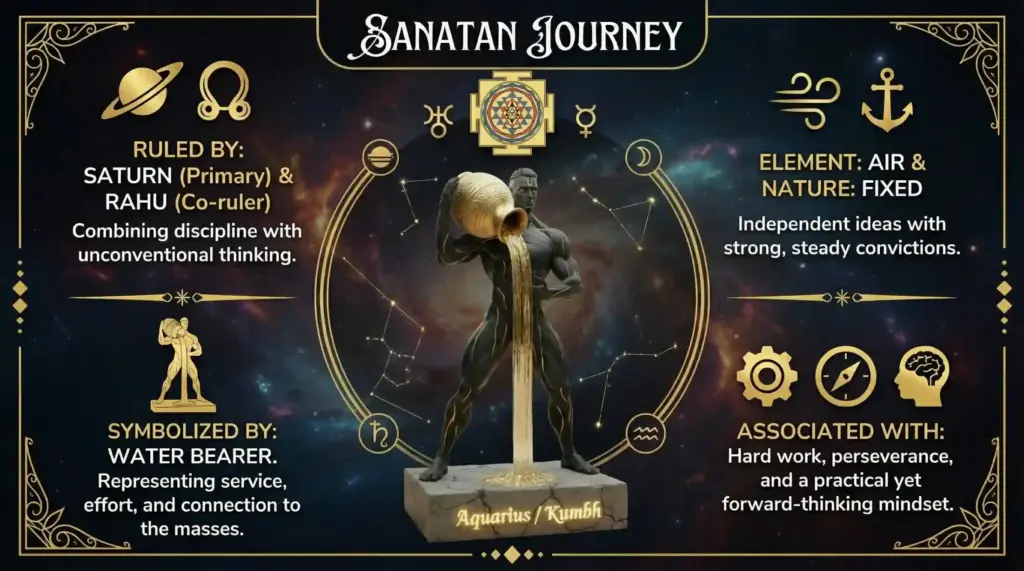
Here’s a quick breakdown of everything you need to know about Kumbha’s core profile, as laid out in BPHS:
| Classification | Details |
|---|---|
| Ruling Planet (Adhipati) | Shani (Saturn) — primary ruler; Rahu — co-ruler (BPHS) |
| Symbol | A man carrying a water pot (Kumbha) on his shoulder |
| Element (Tattva) | Vayu (Air) |
| Modality (Guna) | Sthira (Fixed/Permanent) |
| Caste (Varna) | Shudra (service, hard work, and perseverance) |
| Gender | Male/Masculine (Vishama Rashi — Odd Sign) |
| Direction | West (Paschim) |
| Ayurvedic Dosha | Tri-dosha with a Vata predominance |
| Rising Type | Seershodaya (rises head-first) |
| Active Period | Daytime (Diva Rashi) |
According to BPHS, Saturn owns both Capricorn and Aquarius, but Aquarius is where Saturn performs his most purposeful duty — it’s his Moolatrikona for the first 20 degrees.
Think of it as Saturn’s office. Rahu, sharing ownership of this sign as co-ruler, adds an unconventional, boundary-pushing quality to Kumbha’s nature.
The Shudra Varna classification doesn’t suggest inferiority — it speaks to the sign’s inherent work ethic, service orientation, and connection to the masses. As a Sthira (fixed) Vayu (air) rashi, Kumbha thinks freely but holds its positions firmly.
Symbolism & Puranic Mythology

What does a man carrying a water pot on his shoulder actually mean? That image is Kumbh Rashi. In Vedic tradition, the symbol isn’t the Western “water bearer” pouring water out — it’s the Kumbha itself, the pot, that matters.
The vessel holds everything. It’s a container of Akasha (space), of accumulated wisdom, of karma gathered over lifetimes. Think of it this way: the pot doesn’t just carry water — it holds the potential of what that water could become.
This symbolism connects directly to one of the most iconic stories in all of Vedic literature — the Samudra Manthan, the Great Churning of the Cosmic Ocean. In this Puranic narrative, the Devas and Asuras churned the ocean together using Mount Meru as a churning rod and Vasuki, the great serpent, as the rope.
From this churning emerged fourteen divine gifts, and the most precious of all was the Amrit — the nectar of immortality — held in a Kumbha (divine pot). That pot became the central object of cosmic conflict, a vessel so powerful that entire celestial armies fought over it.
This is the energy Kumbha Rashi carries. It holds within it the highest possible knowledge, just as that pot held the nectar that could grant eternal life. And who pours this wisdom out? The Cosmic Man — the Kaal Purush — whose ankles Kumbha represents in BPHS.
The ankles are what connect the body to the earth, the bridge between the higher self and the physical world. Kumbha, at its core, channels divine knowledge downward into human experience. That’s its eternal purpose.
Fundamental Nature & Tattva
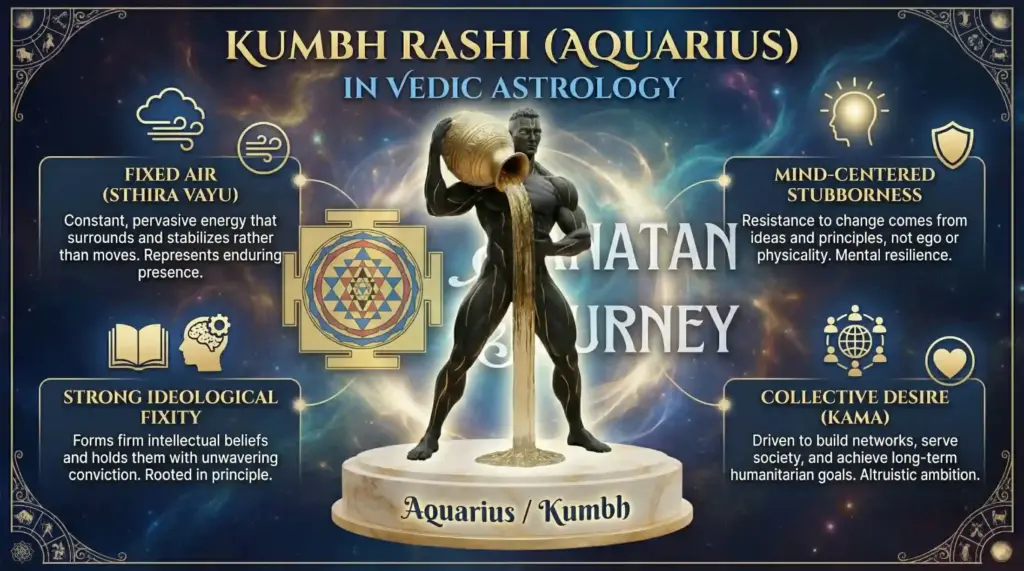
Fixed Air. That combination sounds strange at first. Air moves, right? But Kumbha’s Vayu tattva isn’t a breeze. Gemini gives you moving, curious air — the kind that blows ideas in and out. Libra gives you air in motion, social and balancing.
Kumbha, however, is Sthira Vayu — fixed air. Think of the atmosphere itself. It doesn’t blow around; it wraps the entire Earth, constant and pressurized.
You can’t escape it, and it holds everything in place. That’s the Aquarius Moon Sign energy — pervasive, invisible, and impossible to ignore.
As a Sthira Rashi, Kumbha Lagna people don’t change their minds easily. At all, really. Once they form an intellectual conviction — whether about a philosophy, a system, or a way of seeing the world — they hold it with enormous tenacity.
BPHS confirms this fixed modality across Taurus, Leo, Scorpio, and Aquarius. What makes Kumbha unique is that its stubbornness lives in the mind. It isn’t the physical stubbornness of Taurus or the ego-driven fixity of Leo. It’s ideological.
And what drives all of this? Kama — desire. Kumbha is the 11th sign of the natural zodiac, placing it squarely in the Kama Purushartha category (along with the 3rd and 7th houses).
But this isn’t personal, romantic desire. Kumbha’s Kama is large-scale — the desire to build networks, serve society, achieve collective goals, and see humanity flourish. It wants. It plans. And with Saturn as its ruler, it works patiently until it gets there.
Planetary Dignities & Relationships

When you study Kumbh Rashi through the lens of BPHS, the first thing you notice is how Saturn owns this sign in a very particular way. Yes, Saturn rules both Capricorn and Aquarius — but Aquarius is where he truly operates at his best.
BPHS confirms that the first 20 degrees of Kumbha form Saturn’s Moolatrikona zone. Think of it as the difference between home and office. In Capricorn, Saturn is home — relaxed, comfortable.
In Aquarius, he’s at his office — focused, duty-bound, and fully in performance mode. That’s why planets placed in Kumbha often carry a strong Saturnine quality of discipline, detachment, and hard work.
Now, does any planet get exalted or debilitated in Kumbha? Strictly speaking, no. BPHS doesn’t list any classical exaltation or debilitation point within this sign for the traditional planets.
However, Rahu carries a special connection here — BPHS lists Aquarius as one of Rahu’s own signs, which is why classical tradition recognises him as the co-lord of Kumbha alongside Saturn.
What about planetary friendships? Saturn’s natural friends include Mercury and Venus, and both these planets generally perform well in the Aquarius Moon Sign. Mercury’s analytical sharpness blends nicely with Kumbha’s intellectual air, and Venus finds the social, network-oriented energy here agreeable.
On the other hand, the Sun, Moon, and Mars are natural enemies of Saturn. A Sun placed in Kumbha Lagna often struggles with self-expression, the Moon can feel emotionally detached, and Mars loses some of his directional fire in this fixed, Saturn-ruled environment.
Nakshatra Divisions
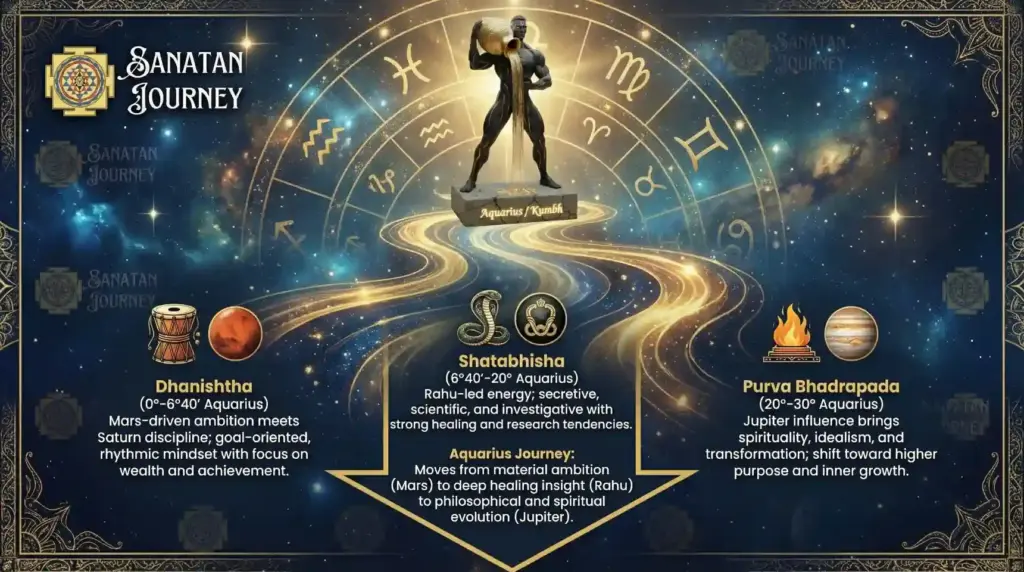
Dhanishtha (Last 2 Padas) — 0° to 6°40′ of Kumbha
Dhanishtha nakshatra runs from 23°20′ of Capricorn all the way to 6°40′ of Aquarius. Its Vimsottari lord is Mars, and its presiding deity is the eight Vasus — the divine attendants associated with abundance, rhythm, and material prosperity.
The portion that falls inside Kumbha covers its 3rd and 4th padas. People with their Aquarius Moon Sign or lagna in this zone carry a potent mix of Mars’s ambition and Saturn’s discipline.
They are goal-driven, rhythmic in their thinking, and have a natural connection to music, wealth accumulation, and structured achievement. There’s a restless, driven quality here that feels almost un-Aquarian on the surface — but look deeper, and you’ll see it’s all in service of a larger vision.
Shatabhisha (All 4 Padas) — 6°40′ to 20°00′ of Kumbha
This is the heart of Kumbha. Shatabhisha means “a hundred healers” or “a hundred medicines,” and it sits entirely within this sign. Its Vimsottari lord is Rahu, and its presiding deity is Varuna — the cosmic god of oceans, hidden truths, and divine law.
The energy here is secretive, scientific, and deeply investigative. People born with strong Shatabhisha placements are the healers, researchers, and system-builders of the zodiac. They carry a powerful need for solitude.
They don’t always share what they know. Also, since this nakshatra falls right within Saturn’s Moolatrikona zone (0° to 20° of Kumbha), planets placed here operate with exceptional Saturnine force.
Purva Bhadrapada (First 3 Padas) — 20°00′ to 30°00′ of Kumbha
The final stretch of Kumbha belongs to Purva Bhadrapada, whose Vimsottari lord is Jupiter and whose deity is Aja Ekapada — the “one-footed goat,” a form of Rudra associated with fierce penance and transformation.
Jupiter’s philosophical depth now meets Saturn’s structure, producing an energy that’s intensely idealistic, spiritually inclined, and willing to make personal sacrifices for a higher cause.
This pada range is where the Kumbh Rashi energy shifts most dramatically — away from worldly ambition and toward inner fire.
So as you move through Kumbha from 0° to 30°, you’re watching a journey unfold: from the ambitious, wealth-seeking drive of Mars in Dhanishtha, through the cool, healing secrecy of Rahu in Shatabhisha, and finally into the philosophical fire of Jupiter in Purva Bhadrapada. Each layer adds depth to what makes the Aquarius zodiac sign so multi-dimensional in Vedic astrology.
Major Karakatvas (Significations)
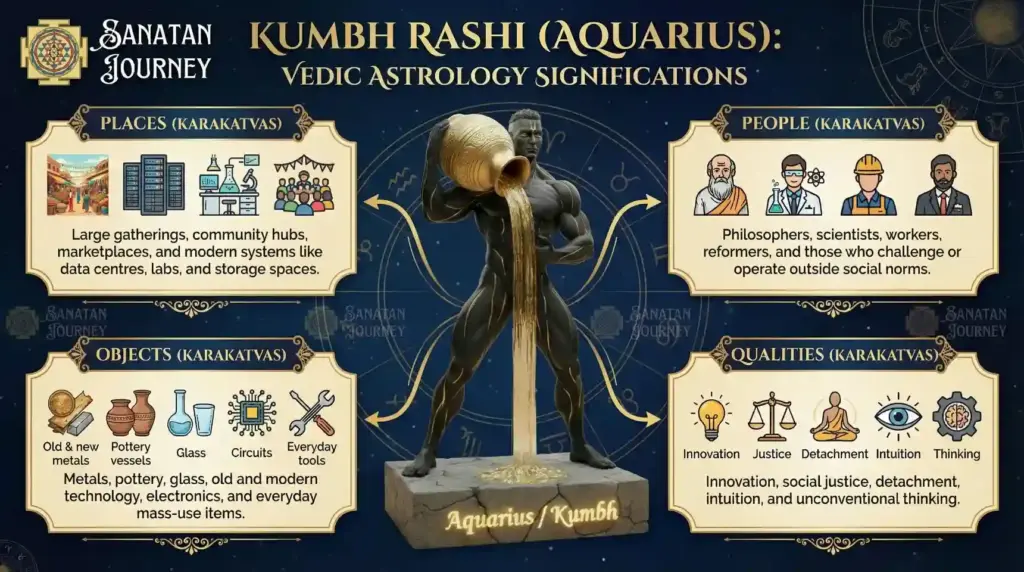
Places
Think of anywhere that gathers people around a shared purpose or system. Kumbha governs large social gatherings, marketplaces, and community spaces.
It also rules places associated with hidden or stored wealth — treasuries, underground storage, and in a modern context, data centres and high-tech laboratories.
Since Rahu co-rules this sign, breweries, distilleries, and pharmaceutical facilities also fall under its domain. Anywhere that people connect at scale, exchange ideas, or process complex systems — that’s Kumbha territory.
Living Beings
Who does this Aquarius zodiac sign represent? Philosophers and scientists sit right at the top of this list — thinkers who challenge established systems and build new ones.
BPHS confirms Saturn’s association with servants and the common working class, so labourers, craftspeople, and those who serve society’s larger machinery also belong here.
In family relationships, Kumbha and the 11th house of the natural zodiac represent the elder sibling. Outcasts, reformers, and social disrupters — people who operate outside conventional structures — carry strong Kumbha energy too.
Objects and Items
Saturn rules iron, coal, and dark-coloured metals. Kumbha extends this to pottery and earthen vessels (a direct nod to its symbol, the Kumbha), glass, old technology, and in modern astrology, cutting-edge innovation and electronics. Root vegetables, aquatic products, and items associated with the masses also fall within its significations.
Abstract Qualities
What you’ll feel most strongly in a Kumbha Lagna or Aquarius Moon Sign person is a powerful drive for social justice, a deep sense of detachment, and genuine intellectual eccentricity. Innovation isn’t just a trait here — it’s a calling.
Add profound intuition, a distrust of superficiality, and an almost impersonal kind of love for humanity, and you get the full picture of what this sign stands for.
Anatomy & Medical Astrology

In the framework of BPHS, the entire zodiac maps onto the cosmic body of the Kaal Purush — and Kumbha rules the ankles. That’s the primary body part you associate with this sign.
More broadly, the sign governs the calves, the lower leg structure, and the left ear in classical Parashari analysis.
Internally, Kumbha connects to the circulatory system — the network that carries blood throughout the body, much like Kumbha itself represents networks and systems in the outer world. The muscular structure of the lower legs also falls under its influence.
Since this is a Vata-dominant sign — ruled by Saturn, the planet of the airy element — health vulnerabilities tend to cluster around Vata-related disorders. You’ll often see ankle fractures, sprains, or ligament issues in people with a heavily afflicted Kumbha.
Varicose veins and poor blood circulation in the lower limbs are common concerns too. Nervous tension, chronic anxiety, erratic sleep, and blood-related disorders also show up frequently, all pointing back to Vata’s tendency toward instability and dryness when unbalanced.
If Saturn or Rahu afflicts Kumbha in a chart, paying attention to these areas becomes quite relevant in a medical reading.
Strength Factors (Day/Night & Rising)

Every rashi in Vedic astrology carries a built-in set of strength factors — and for Kumbh Rashi, these factors reveal a sign that works best in conditions of clarity, light, and direct engagement.
Rising Type: Seershodaya (Head-Rising)
BPHS places Aquarius firmly among the Seershodaya rashis — signs that rise head-first on the eastern horizon. Gemini, Leo, Virgo, Libra, Scorpio, and Aquarius all share this classification. What does it mean practically?
Planets placed in Seershodaya signs tend to deliver their results in the first half of their dasas, rather than at the end. It also signals that the sign operates through intellectual directness. The head rises first — meaning logic, clarity, and mental orientation lead the way in all Kumbha matters.
Time Strength: Diva Bali (Daytime Sign)
Kumbha belongs to the category of Diva rashis — signs that are strong during the daytime. BPHS confirms this alongside Leo, Virgo, Libra, Scorpio, and Pisces in the same group.
This means that planets placed in Kumbha generally perform better in day charts, and Kumbha-related matters find sharper expression when activated under solar influence.
Classification: Biped (Human) Sign
Kumbha is a biped rashi — a human sign, alongside Gemini, Virgo, Libra, and the first half of Sagittarius. This classification speaks to high rational capability, social orientation, and the capacity for conscious, deliberate action.
Unlike quadruped signs (which lean toward instinctual behaviour), biped signs like Aquarius operate through thought, choice, and community.
Personality Traits (Ascendant/Moon)

So what does a Kumbh Rashi person actually look and feel like? Whether you’re reading for someone with Kumbha Lagna or an Aquarius Moon Sign, the character that comes through has a very specific quality — one that’s hard to miss once you know what to look for.
Physical Appearance
BPHS describes Kumbha as tall and bony, with small eyes and coarse hair. The overall build tends to be lean and angular rather than soft or rounded.
There’s often a kind of angular prominence to the forehead that gives the face an intellectual quality. The eyes, though described as small, frequently carry a faraway, reflective look — as if the person is simultaneously in the room with you and somewhere else entirely.
Ill-formed or irregular teeth and a somewhat sparse physical presentation are also noted in the classical description.
Mental Temperament
At their core, Kumbha Lagna and Aquarius Moon Sign people are unconventional thinkers. They don’t follow mental paths that others have already worn smooth — they build new ones.
BPHS describes this sign as philosophical and charitable in nature, and Saturn’s influence adds a layer of stoic practicality underneath the idealism.
These people can hold a paradox comfortably: deeply intuitive yet analytically minded, warmly humanitarian yet personally detached.
They’re frequently misunderstood, not because they’re obscure, but because they think in systems and patterns that others haven’t caught up to yet.
Positive Traits
Honesty sits at the top of the list — BPHS directly notes this quality. Add to that a genuine humanitarian instinct, a deep egalitarian streak (they really do believe everyone deserves equal consideration), and an inventive mind that can’t stop generating ideas.
Loyalty, once earned, is ironclad. They also carry an unusual capacity for hard work — Saturn’s imprint ensures that.
Negative Traits
However, the same detachment that makes them fair and objective can tip into emotional distance. They can feel cold to people who need warmth and reassurance.
Kumbha’s fixed nature makes them stubborn about ideas — sometimes rebellious just for the sake of standing apart, rather than because the rebellion serves any real purpose.
Also watch for sudden withdrawal. When overwhelmed, a Kumbha person doesn’t process publicly — they simply disappear, leaving the people around them confused and shut out.
Read About Meen Rashi (Pisces)
Read About Makar Rashi (Capricorn)

Frequently Asked Questions
Which planet is the Lord of Kumbha Rashi?
Saturn (Shani) is the primary ruler. Rahu acts as co-ruler, as per BPHS.
Is Aquarius a water or air sign in Vedic Astrology?
Despite the water-pot symbol, Kumbha is a Vayu (Air) Tattva Rashi — not water.
What is the lucky stone for Kumbha Rashi?
Blue Sapphire (Neelam) is generally recommended, but always verify with your individual horoscope first.
Which body parts does Kumbha represent?
Kumbha governs the ankles, calves, and the circulatory system of the lower body.
Is Kumbha a fixed sign?
Yes. Kumbha is a Sthira (Fixed) Rashi, making it stable, persistent, and intellectually stubborn.
Which Nakshatras fall under Kumbha Rashi?
Dhanishtha (last 2 padas), Shatabhisha (all 4 padas), and Purva Bhadrapada (first 3 padas) fall here.