


In Vedic astrology, this Moon in ascendant placement joins Chandra, the graha of mind, with Lagna, the house of body, self, and personality; in Kalpurush Kundali, Aries marks the natural 1st house.
You feel things fast, and people can read your face and mood with ease, because Moon shapes the mind and Lagna shapes the self. A strong or waxing Moon can give charm, vitality, empathy, and public appeal, while a weak or waning Moon can bring mood swings, health sensitivity, and an unsteady self-image. You may also share a deep bond with your mother.
Brief Talking Points:
- Moon in 1st House connects your mind and personality, so your emotions strongly shape how you look, act, and respond to life.
- This placement makes you soft, caring, and expressive, and people can often read your feelings from your face.
- A strong Moon in Lagna can bring charm, popularity, and emotional warmth, especially when the Moon is waxing and well-placed.
- A weak or afflicted Moon can cause mood swings, overthinking, and self-doubt, because the mind directly affects the self here.
- Moon in the ascendant also influences relationships, because it aspects the 7th house and makes emotional bonding very important in marriage and partnerships.
Detailed Analysis of the Planet (Graha) — Chandra (Moon)
Tattva (Element)
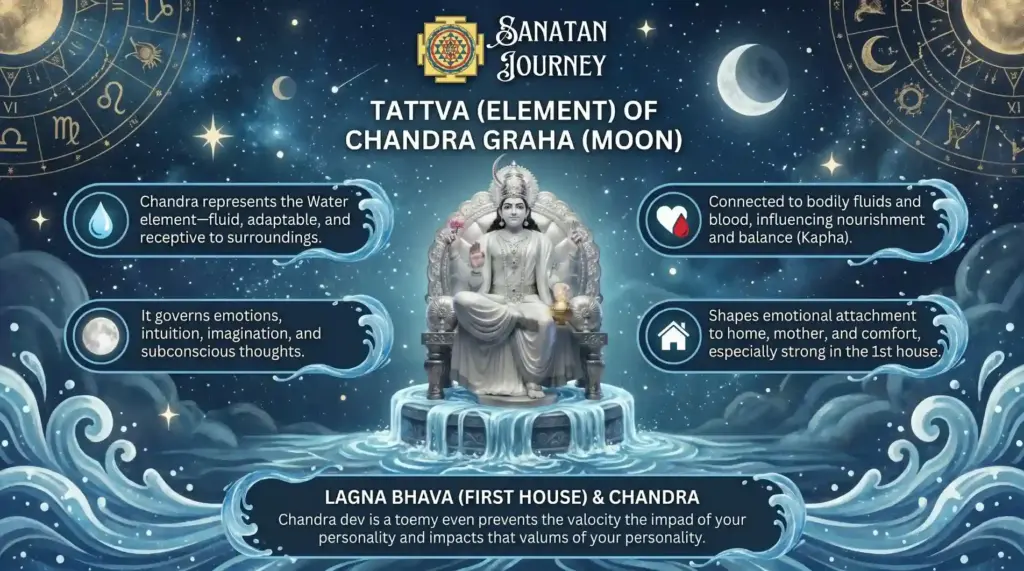
Chandra governs Jala Tattva — the Water Element.
Think of water. It has no fixed shape. Pour it into a cup and it becomes the cup. Pour it into a river and it flows freely. Moon works exactly the same way. It’s fluid, receptive, and always adapting to its surroundings.
In Vedic astrology, Moon is the primary ruler of the water element — and this shows up in everything it touches. It governs your emotions, your imagination, your gut feelings, and the quiet thoughts that float in your mind at 2 AM.
Moon also rules blood (Rakta) among the seven body materials (Sapta Dhatus), and all bodily fluids more broadly. In Ayurvedic terms, it connects to Kapha dosha — that combination of earth and water that nourishes and binds the body together.
Your attachment to your home, your mother, your food preferences — all of these have a Jala Tattva quality rooted in Chandra’s nature. And when Moon sits in the 1st house, all that flowing, nurturing water energy shapes how you show up in the world.
Karakatva (Significations)
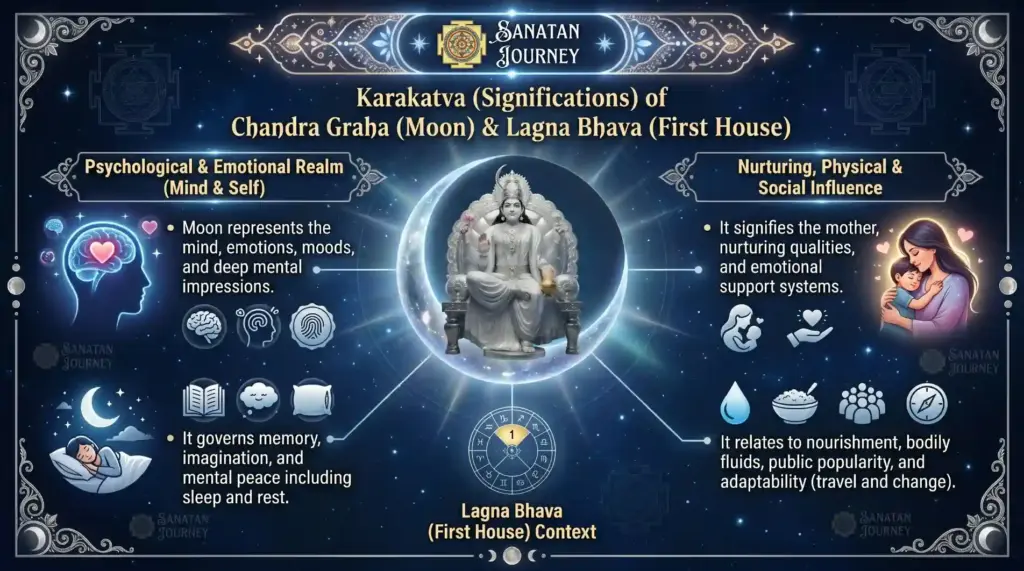
So what does Chandra actually represent? Quite a lot, actually.
At its core, Moon signifies your mind (Manas). Not just your thoughts, but your emotional reactions, your moods, your memory, and the deep impressions that experiences leave on you. In Brihat Parashara Hora Shastra, Parashara clearly states: “Moon governs mind.
Here’s a quick overview of what Moon covers as a natural significator (Naisargika Karaka):
- Mind, emotions, and mood — your inner emotional world
- Mother (Maata) — the most important maternal figure in your life
- Memory and imagination — your ability to recall and visualise
- Blood and bodily fluids — physical nourishment and fluid balance
- Public popularity and the masses — how ordinary people respond to you
- Food, water, and nourishment — what feeds and sustains you
- Sleep, rest, and mental peace — your ability to switch off and recover
- Travel, especially over water, and change of residence
- Fertility and feminine cycles — conception, hormonal rhythms
- Caregivers, nurses, farmers, and public servants — those who nurture others
When Moon is in your Lagna Bhava, all of these significations become part of your personal identity and physical self. Your personality carries Moon’s qualities directly.
Nature (Saumya / Krura)
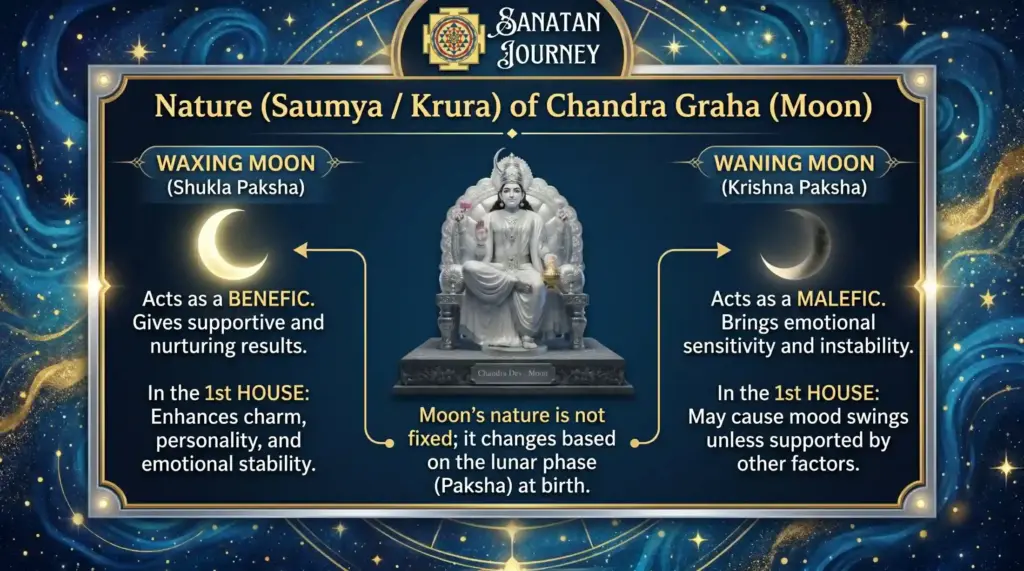
Here’s something many people don’t know: Moon isn’t permanently good or permanently bad. Its nature changes based on the lunar phase (Paksha) at your time of birth.
Waxing Moon (Shukla Paksha): Moon is a natural benefic — a Saumya Graha. It gives supportive, auspicious, and nurturing results.
Waning Moon (Krishna Paksha): Moon behaves as a natural malefic — a Kroora Graha. It can bring emotional challenges and instability.
The Brihat Parashar Hora Shastra puts it plainly: “Waxing Moon of Shukla Paksha is a natural benefic. Waning Moon of Krishna Paksha is a natural malefic.”
This matters a great deal for the Moon in the 1st house placement. A waxing Moon in Lagna can bless you with charm, vitality, and emotional stability. A waning Moon in the same spot may make you emotionally sensitive, prone to mood swings, or physically delicate — unless other chart factors support it.
Planetary Relationships
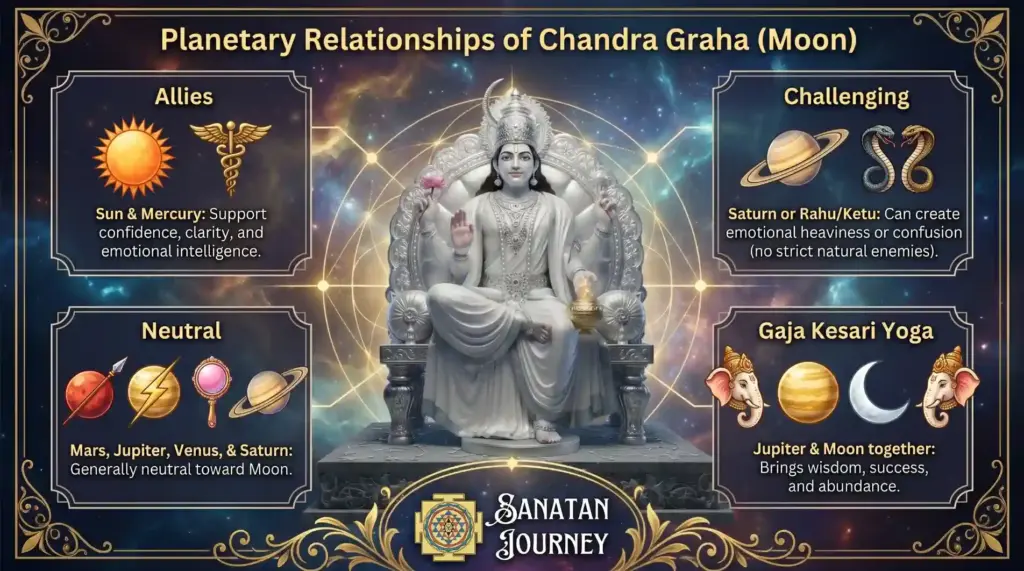
Friends (Mitra)
Moon’s natural friends are Sun and Mercury.
Sun and Moon share a beautiful relationship in Vedic astrology. Together with Lagna, they form the “tripod of life” — Lagna governs the body, Moon governs the mind, and Sun governs the soul. When Moon in the 1st house is joined or aspected by the Sun, it can give a strong, confident personality with a clear sense of self.
Mercury, Moon’s other friend, brings clarity, communication, and wit to the picture. A well-placed Mercury supporting Moon in Lagna can give a sharp, expressive, and emotionally intelligent personality — someone who can articulate feelings with ease.
Enemies (Shatru)
Classically, Moon has no permanent natural enemies listed in BPHS. Mars, Jupiter, Venus, and Saturn are all neutral to Moon in the naisargika (permanent) friendship scheme.
That said, two combinations deserve special attention:
Visha Yoga forms when Saturn conjuncts Moon. Saturn’s cold, dry, and restrictive energy clashes with Moon’s need for warmth and flow. In the 1st house, this can cause emotional heaviness, pessimistic thinking, or a deep fear of vulnerability.
Grahan Yoga forms when Rahu or Ketu conjoin Moon. These shadow planets disturb Moon’s natural clarity, and in Lagna, this can create confusion about identity, mental restlessness, or a tendency toward anxiety and fear.
Neutrals (Sama)
Moon’s neutral planets are Mars, Jupiter, Venus, and Saturn.
Of these, Jupiter deserves a special mention. When Jupiter occupies a Kendra (quadrant — 1st, 4th, 7th, or 10th house) from the Moon, it forms the famous Gaja Kesari Yoga — one of the most celebrated combinations in Vedic astrology. This yoga can bring wisdom, fame, and abundance. For a native with Moon in the 1st house, Jupiter in the 4th, 7th, or 10th from Lagna activates this powerful yoga directly.
Venus, sharing the same Jala Tattva as Moon, blends harmoniously in most placements. Its presence can add grace, artistic sensitivity, and a love of beauty to the personality.
Aspects (Drishti)
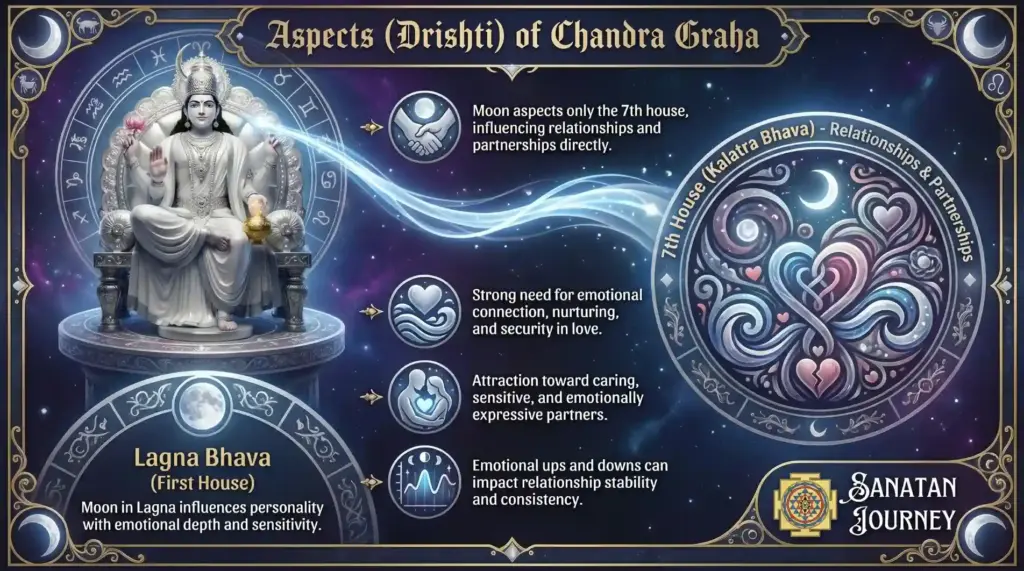
Every planet in Vedic astrology has the ability to aspect, or “look at,” other houses. Moon aspects the 7th house from wherever it sits through its standard Graha Drishti.
Unlike Mars, Jupiter, or Saturn — which carry special additional aspects — Moon has only one aspect: the 7th house aspect. It doesn’t look to the 4th, the 8th, the 3rd, or the 10th. Just the 7th.
So when Moon sits in the 1st house (Lagna Bhava), it directly aspects the 7th house — Yuvati Bhava, the house of marriage, partnerships, and long-term relationships.
What does this mean for you? Your emotional world bleeds into your relationships. You look for nurturing, emotional safety, and deep feeling-based connection in a partner. The people you choose to love often carry lunar qualities — they may be caring, home-loving, expressive, or deeply sensitive.
Also, Moon’s aspect on the 7th can make love marriages more likely, and your popularity in social circles tends to grow over time, especially after your mid-twenties.
One thing to watch: this aspect also brings the waxing and waning quality of Moon into relationships. When you’re emotionally full (like a full moon), your relationships thrive. When you’re emotionally depleted, you may pull back — and that inconsistency can confuse your partner.
Dignity and Strength
Not all Moon placements are equal. Where Moon sits in the zodiac — its sign, degree, and dignity — makes a big difference in how well it performs in Lagna. Here’s what each state means.
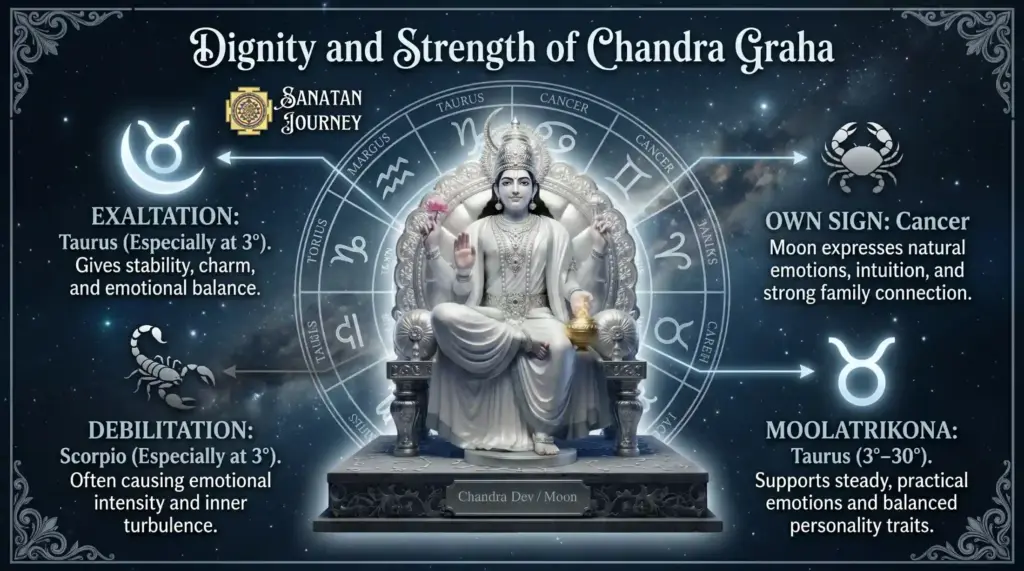
Exaltation (Uchcha)
Moon is exalted in Taurus (Vrishabha), with its deepest exaltation at 3° Taurus.
Think of it like this: Taurus is Moon’s favourite picnic spot. It’s stable, earthy, beautiful, and comfortable. Moon absolutely loves being here.
The first 3° of Taurus gives full exaltation results. The remaining 27° of Taurus operates as Moon’s Moolatrikona.
If Taurus is your rising sign and Moon is placed in Lagna at or near 3°, you carry one of the most powerful Moon placements in all of Vedic astrology. It can give beautiful appearance, emotional steadiness, wealth, and genuine public love.
Debilitation (Neecha)
Moon is debilitated in Scorpio (Vrischika), with the deepest debilitation at 3° Scorpio.
Scorpio is intense, secretive, and transformative. Moon, which craves safety, openness, and gentle flow, feels very out of place here. When Moon in the 1st house falls in Scorpio, it can create emotional extremes — deep sensitivity that sometimes tips into fear, obsession, or psychological turbulence.
That said, debilitation isn’t a life sentence. If Neecha Bhanga (cancellation of debilitation) applies — for instance, if the debilitation lord is strongly placed — Moon can still deliver surprisingly strong results. Always check the full chart.
Own Sign (Swarashi)
Moon owns only one sign: Cancer (Karka Rashi).
Cancer is the 4th sign of the natural zodiac — the house of home, mother, emotions, and inner peace. Moon in Cancer is like a person finally home after a long day. It’s natural, relaxed, and completely itself.
For someone with Cancer Lagna and Moon in the 1st house, this is a beautifully warm placement. You tend to have strong emotional intelligence, deep family ties, powerful intuition, and an almost magnetic maternal warmth that draws people to you.
Moolatrikona
Moon’s Moolatrikona is Taurus, covering 3° to 30°.
The Brihat Parashar Hora Shastra describes Moolatrikona as a planet’s “office” — the place where it works with full duty and purpose. In Taurus beyond 3°, Moon is focused, steady, and productive. It’s strong, dignified, and purposeful.
For Moon in Lagna in Taurus (after the 3° exaltation zone), the results are still excellent — grounded emotional wisdom, material stability, and a calm, attractive personality.
States (Avasthas)
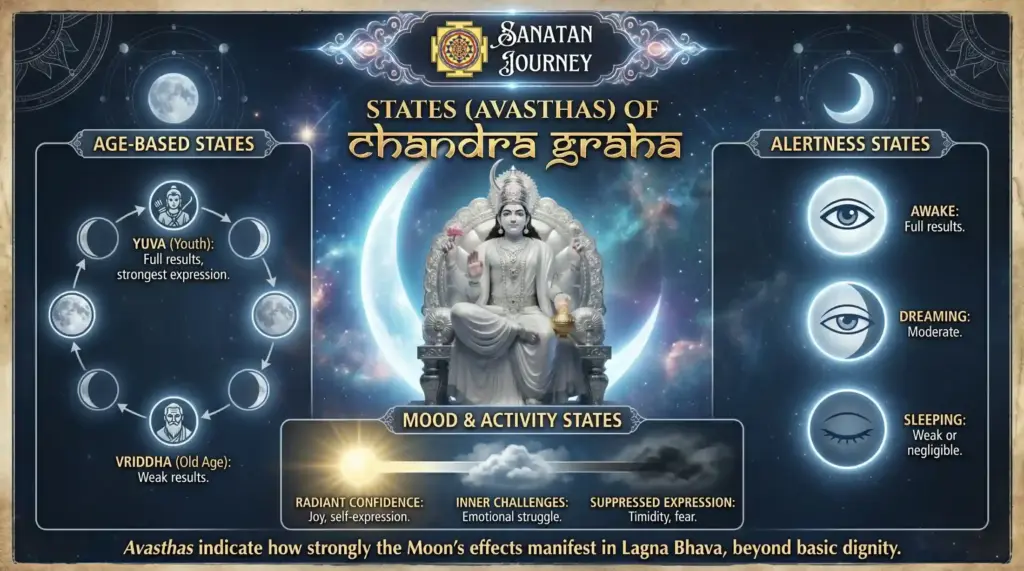
Beyond dignity, Parashara gives us another important tool: Avasthas — the states of a planet. These states tell you how much of Moon’s results will actually manifest in Lagna.
Age-Related States
Every planet has an “age” based on its degree in a sign.
In odd signs (Aries, Gemini, Leo, Libra, Sagittarius, Aquarius): 0°–6° = Saisava (Child, 1/4 results); 6°–12° = Kumara (Adolescent, 1/2 results); 12°–18° = Yuva (Youth, full results); 18°–24° = Vriddha (Old, partial results); 24°–30° = Mrita (Dead, no results)
In even signs (Taurus, Cancer, Virgo, Scorpio, Capricorn, Pisces): the sequence reverses — 0°–6° = Mrita, 6°–12° = Vriddha, 12°–18° = Yuva, 18°–24° = Kumara, 24°–30° = Saisava
Moon in Yuva (Youth) avastha in Lagna gives its full significations without restriction — charm, emotional warmth, strong personality, and public appeal all express freely.
Alertness States
This tells you how awake Moon is.
Jagrita (Awake): Moon in Cancer (own sign) or Taurus (exaltation) — gives 100% results. The most powerful state for Moon in the 1st house.
Swapna (Dreaming): Moon in a friendly or neutral sign — gives medium results. For example, Moon in Aries Lagna sits in a friendly sign (Sun rules Aries, and Sun is Moon’s friend), so it’s in Swapna — moderate-to-good results.
Sushupta (Sleeping): Moon in Scorpio (debilitation) or an enemy-ruled sign — results are negligible unless other factors compensate.
Mood and Attitude States
These nine mood states (Deeptadi Avasthas) describe the inner emotional quality of Moon’s expression in Lagna.
Deepta (Bright): Moon at 3° Taurus — peak radiance, joy, and personality magnetism
Swastha (Comfortable): Moon in Cancer — natural, self-assured, and emotionally grounded
Mudita (Delighted): Moon in a friend’s sign like Leo or Mercury’s signs — cheerful and positive self-expression
Duhkhita (Distressed): Moon heavily afflicted by Saturn or Rahu in Lagna — emotional sorrow and identity confusion
Vikala (Crippled): Moon joined by malefics in Lagna — compromised emotional health and physical vitality
A Moon in Deepta or Swastha avastha in Lagna creates a person who radiates calm confidence and genuine warmth. A Moon in Duhkhita or Vikala avastha asks the native to do deeper inner work before that potential can shine through.
Activity States
The 12 activity states (Shayanaadi Avasthas) — including Sayana (sleeping), Prakasana (shining), Gamana (moving), Nrityalipsaa (longing to dance), and Nidra (sleeping), among others — are calculated using Moon’s nakshatra, the ghatis elapsed since sunrise, and the Lagna at birth.
Each state gives a different flavour to how Moon delivers results in the ascendant. A Moon in Prakasana (shining) state in Lagna gives the native fame, a luminous aura, and visibility in public life. A Moon in Nidra (sleeping) state suppresses self-expression and may make the native inward or under-confident until they consciously work to activate their lunar energy.
Analysis of the House (Bhava) — 1st House / Lagna Bhava
Governing Areas
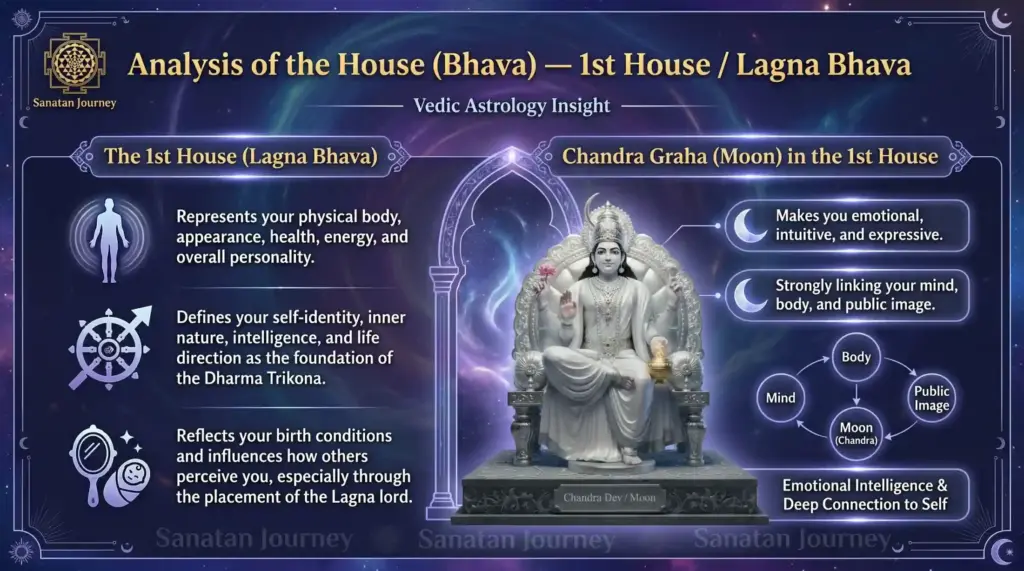
In Vedic astrology, we call this the lagna bhav. It represents you! It shows your physical body (Tanu), your overall appearance, and your natural complexion. It also controls your health, strength, energy levels (Bala), and basic vitality.
Think of the first house as the steering wheel of your life. It shapes your personality, your true inner nature (Svabhava), and your self-identity. It even guides your intelligence (Jnana) and any fame (Kirti) you might get. This house acts as the root of the Dharma Trikona. This triangle of purpose includes the 1st, 5th, and 9th houses, and it points you toward your life’s true direction.
The lagna bhav also tells the story of your birth. It reveals the exact environment and conditions around you when you entered the world. If we look at the natural zodiac (Kalpurush Kundali), the first house is Aries. Because Aries rules the head and brain, your ascendant house often relates to your head, though the exact body part depends on your specific rising sign.
Brihat Parashar Hora Shastra teaches a famous rule: “Tanum rupam cha jnanam cha, varnam chaiva balabalam | Prakrutim sukha duhkham cha, tanubhavad vichintayet.” This simply means you look at the first house to figure out a person’s body, knowledge, skin tone, strength, nature, happiness, and sorrow.
Did you know the first house acts like a superhero in your chart? It works as both a Kendra (angular house) and a Trikona (trine house) at the exact same time! We also use it to find your Arudha Lagna, which shows how the world actually sees you. Always remember to check where your lagna lord sits, because that specific planet controls how well your first house works!
Planet’s Impact on the House
What happens when you have Moon in 1st house? This magical placement beautifully fuses your mind and your body together. Your emotional states become the main lens through which you experience the world. You literally wear your heart on your sleeve!
When Chandra graha sits in your ascendant, your physical appearance takes on lovely lunar qualities. You might develop a fair or pleasant complexion, very soft features, and highly expressive eyes. People often notice a round or full face, a youthful glow, and a very soothing aura around you.
Your personality becomes deeply feeling-based. You act empathetic, intuitive, and nurturing. You easily pick up on the emotional vibrations of the people around you.
Because your Lagna and your Chandra Lagna (Moon sign) are exactly the same here, you get a massive double effect! Any planetary movement that hits your Moon will hit your physical self at the exact same time.
From the lagna bhav, the Moon looks straight across and aspects your 7th house. This brings deep emotional sensitivity and a strong desire for connection into your marriage and business partnerships. The general public usually loves you too, thanks to the Moon’s natural ability to connect with the masses.
Your mother also plays a massive role in your life. Her personality, her emotional style, and her habits leave a deep imprint on your own identity and mannerisms.
Does the Moon’s phase matter? Yes, absolutely! When you have a waxing Moon (Shukla Paksha), you radiate beauty, vitality, emotional generosity, and prosperity. But if you have a waning Moon (Krishna Paksha) or an afflicted Moon, you might face emotional volatility, health sensitivity, mood swings, and a fluctuating self-image.
“With Moon in the 1st house, the native embodies the essence of Chandra in its purest form — the self waxes and wanes like the Moon itself. In strength, they radiate warmth, nurturing grace, and magnetic popularity; in weakness, they recede into emotional tides, searching for a stable shore within themselves.”
Detailed Predictions (by Life Area)
Personality and Character
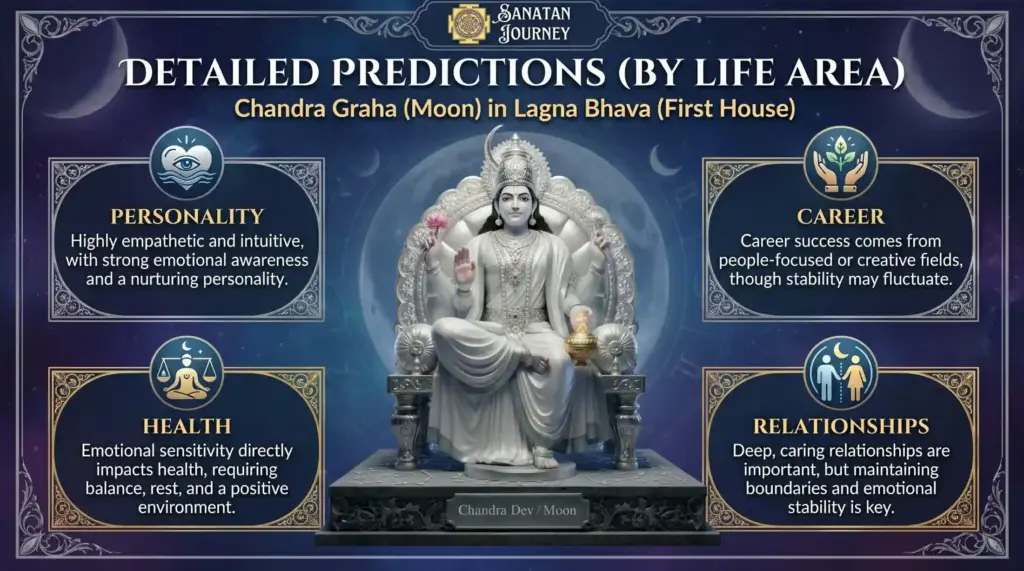
Do people always know exactly how you feel? With Moon in 1st house, you literally wear your heart on your sleeve. You sense the emotions of others naturally and quickly read any room. You probably act a lot like your mother, mirroring her nurturing ways in your daily life.
Your sense of self changes just like the lunar phases. Some days you feel totally confident, while other days you need quiet time to think. People simply love you because you act charming, adaptable, and socially magnetic.
However, if your Chandra graha feels weak in your birth chart, you might get moody or take simple things too personally. You love to create, and you feel naturally drawn to art, music, and poetry. As you grow older, you make better choices and gain emotional balance. You remember past events deeply and always want to take care of the people around you.
Career and Public Image
What kind of job suits you best? You make an excellent nurse, counselor, or caregiver. Since the Moon rules the masses, you shine in public-facing jobs like hospitality, retail, or
politics. Do you love to express yourself?
You can easily succeed in music, writing, or dance because your watery imagination flourishes there. Jobs related to water, farming, or travel also fit you perfectly. You might even love teaching little kids or doing social work.
The public sees you as a warm, approachable, and friendly person. You gain recognition because people connect with you emotionally, not because you act bossy or aggressive. Your career might go through ups and downs, just like the Moon waxes and wanes. Also, you might change jobs frequently, especially during a Moon dasha.
Health and Well-being
Let’s talk about your health. The Moon controls your blood, which Vedic astrology calls Rakta Dhatu. You might face blood pressure changes, anemia, or lymphatic issues. Does stress make your stomach hurt? Your emotions quickly affect your physical body. You might feel pain in the body part controlled by your ascendant sign. For example, an Aries rising might get frequent headaches.
You could have trouble sleeping or experience wild, vivid dreams. You might hold onto water weight or have kidney and hormonal sensitivities. If your Moon acts strong, you digest food beautifully. The classic astrological book Phala Deepika says a waxing Moon in the lagna bhav gives you a strong body and a long life. But a waning Moon makes your constitution physically weaker. You need plenty of water, good sleep, and happy environments to stay healthy.
Relationships and Partnerships
How do you handle love? From your first house, the Moon looks directly at your 7th house of marriage. You desperately want emotional safety and deep connections. Partners flock to you because you act so warm and empathetic. You love taking a nurturing role with your spouse.
Your romantic relationships pack a lot of emotion. You feel amazing highs and deep lows depending on your Moon’s strength. Sometimes, you might cling too tightly to your partner and struggle to set healthy boundaries. Your future husband or wife might act very sensitive, love staying at home, or have strong Cancerian traits. You easily build large groups of friends who love your generous heart. If your Moon feels afflicted, you might get grumpy and confuse your partner.
Strengths and Weaknesses
Strengths
- You possess incredible emotional intelligence and understand how others feel.
- You act naturally charming, and people instantly like your warm personality.
- Your strong intuition helps you know things without logical proof.
- You freely give love, support, and care to everyone.
- You adapt to new situations easily, flowing just like water.
- You create beautiful art and music naturally.
- You share a powerful, supportive bond with your mother.
- A waxing Moon gives you physical beauty and amazing vitality.
Weaknesses
- Your confidence bounces up and down based on your feelings.
- You take criticism too personally and get hurt easily.
- You struggle to maintain healthy boundaries in your relationships.
- You find it hard to make decisions when your feelings conflict.
- Your body gets sick when your mind feels stressed.
- A waning Moon can make you fearful and physically tired.
- You worry too much and suffer from restless thoughts.
- You rely too heavily on other people’s approval to feel good about yourself.
Overall Prediction and Results
First House (Tanu Bhava) — Moon’s Direct Placement
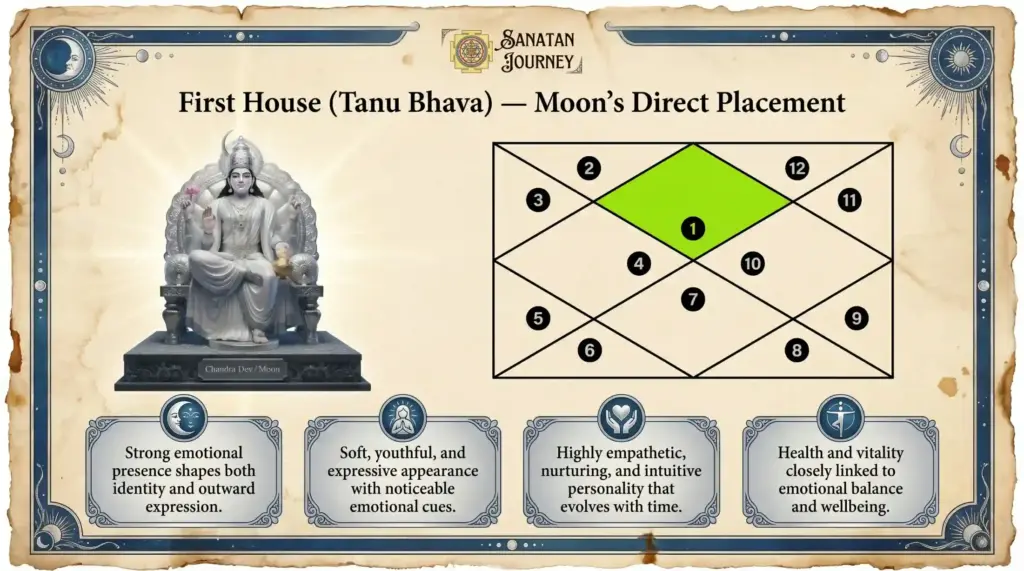
This house represents your true self. When your Moon sits right here, you can expect some very specific things to happen:
Physical Appearance: You will likely develop a fair, pleasant, or luminous complexion. People often notice your soft and expressive features. You carry a youthful appearance that lasts your entire life. Your emotional states show up instantly in your facial expressions and body language, giving you a very soothing and magnetic physical presence.
Personality: Your mind and your identity fuse together completely — you truly are your emotions! You act deeply empathetic, intuitive, and nurturing toward everyone. Your self-image changes frequently, mirroring the Moon’s natural phases. You express a strong maternal and caring archetype through your daily personality. While you might feel highly impressionable in your youth, you will gain beautiful emotional maturity over time.
Health: Your physical constitution ties directly to your emotional wellbeing. You might notice blood and fluid-related sensitivities, along with psychosomatic tendencies where stress makes your body ache. A waxing Moon gives you a very strong constitution, while a waning Moon makes it slightly weaker. You benefit greatly from emotional nourishment, proper rest, and lunar health practices.
Overall Nature: You act wonderfully adaptable, people-oriented, imaginative, and emotionally generous. You leave a lasting impression on others through your feelings rather than through force. You stay deeply connected to your home, your mother, and your family roots.
Seventh House (Yuvati Bhava) — Moon’s Aspect from 1st House

Because your Moon sits in the first house, it looks directly at your seventh house. Here is what that means for you:
Spouse: The Moon’s aspect on your 7th house brings incredible emotional depth and nurturing qualities directly to your spouse. Your partner will likely act sensitive and caring. They might even work in public-serving or creative fields! The Moon’s influence makes your spouse very emotionally expressive, though they can act a bit moody sometimes.
Marriage: Your marriage runs entirely on feelings and emotional drives. You seek emotional security above all else in a romantic partner. Just like the Moon’s phases, your marriage might go through natural cycles of emotional closeness and distance. However, when your Moon feels strong, you will enjoy a deeply caring and home-centered marital life.
Business: You will find great success in partnerships related to public-serving businesses, food, hospitality, creative arts, or caregiving professions. Emotional compatibility with your business partners matters just as much to you as the business itself!
Public Relations: You project a warm, approachable, and emotionally resonant public image. The general public genuinely likes and trusts you. Any fame you achieve will come directly through your powerful emotional connection with the masses.
Final Summary
Moon in the 1st house joins Chandra graha, the ruler of mind, with lagna bhav, the seat of body, identity, and lived experience, so your feelings quickly shape how you think, look, react, and connect with the world. In Vedic astrology, this placement often gives softness, empathy, public warmth, and a face that openly reflects inner emotion.
At its best, this Moon in ascendant placement gives emotional wisdom, compassion, intuition, and a caring presence that comforts other people. At its harder edge, it can bring mood swings, over-sensitivity, and a changing self-image, especially when the Moon is weak, waning, or afflicted.
Your lesson is not to fight emotion, but to steady it. The Moon in lagna teaches you to stay rooted inside yourself while the tides of feeling rise and fall. When you learn that, you stop drowning in emotion and start holding it with grace.

Frequently Asked Questions
What happens when Moon is in the 1st house?
You become highly emotional, deeply caring, and your face easily shows your true feelings to everyone around you.
Does Moon in the 1st house affect physical appearance?
Yes! It gives you a pleasant, youthful face, soft features, and a glowing, magnetic physical presence.
Is Moon in the 1st house good for marriage?
Yes, you naturally seek deep emotional bonds, making you a very loving and nurturing partner in marriage.
What career suits someone with Moon in Lagna?
You excel in caregiving, nursing, teaching, psychology, public relations, or creative arts like music and writing.
What career suits someone with Moon in Lagna?
You excel in caregiving, nursing, teaching, psychology, public relations, or creative arts like music and writing.
Does the Moon’s phase matter in the 1st house?
Yes! A waxing Moon brings health and joy, while a waning Moon can cause mood swings and worry.