


Have you ever wondered why some people are just born with an unshakeable work ethic and a hunger for achievement? Well, Makar Rashi might have something to do with that. In Vedic astrology, Makar is the 10th sign of the natural zodiac — and it sits right at the top.
In the Kaal Purush Kundali, which you can think of as the cosmic blueprint of a human being, Makar governs the 10th house. This house has a Sanskrit name: Karmasthan — literally, the “house of action.”
It’s the highest point of the zodiac, the very zenith. If you’re looking for the sign that represents worldly ambition, career, public reputation, and disciplined karma, Makar is it.
Ruled by Saturn (Shani), this Saturn-ruled sign in the Vedic chart carries the energy of structure, patience, and calculated effort. It’s the sign where karma gets serious — and where real-world achievement gets built, brick by brick.
Classification & Key Statistics
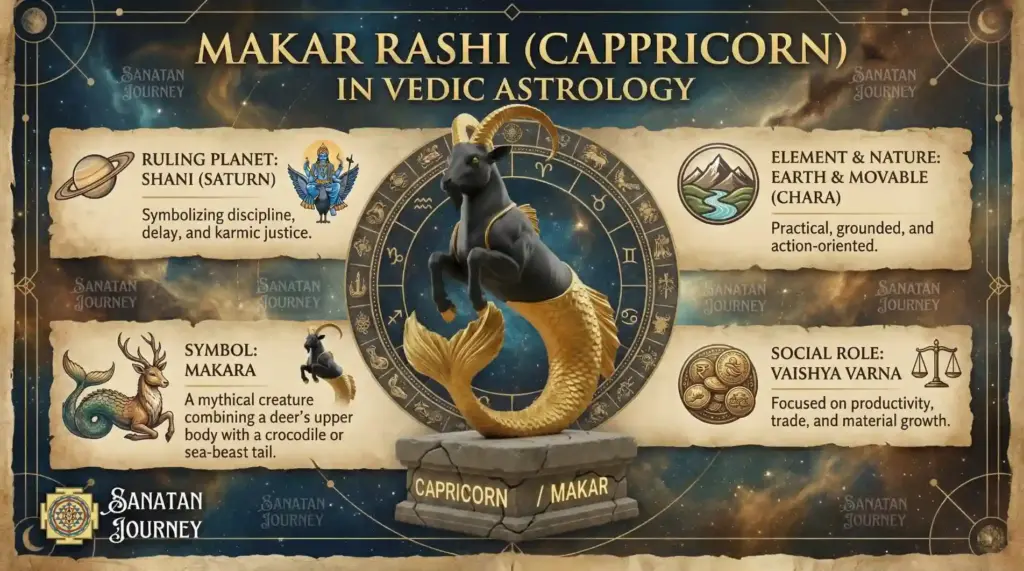
Before you get deep into Makar Rashi traits, it helps to see the basics laid out clearly. Here’s what BPHS and classical Vedic astrology tell us about the core attributes of this Capricorn sign in Vedic astrology:
| Attribute | Detail |
|---|---|
| Ruling Planet (Adhipati) | Shani (Saturn) — planet of discipline, delay, and karmic justice |
| Symbol | The Makara — a mythical creature with the upper body of a deer and the lower body of a crocodile or sea-beast |
| Element (Tattva) | Prithvi (Earth) — grounded, solid, and constant in nature |
| Modality (Guna) | Chara (Movable/Cardinal) — dynamic and driven to initiate |
| Caste (Varna) | Vaishya — the productive, business-oriented class |
| Gender | Female (Even/Negative sign) |
| Direction | South |
| Ayurvedic Dosha | Vata (Windy) — governed by Saturn’s airy, dry quality |
As BPHS describes, earthy signs like Makar represent the Vaishya varna — those who produce, trade, and build material value in the world. That lines up perfectly with Makar’s reputation as the sign of career and commerce in 10th house astrology.
Symbolism & Puranic Mythology
What does Makar Rashi actually look like? The symbol of the Makara is one of the most fascinating in all of Vedic astrology. It’s not a simple animal — it’s a hybrid creature.
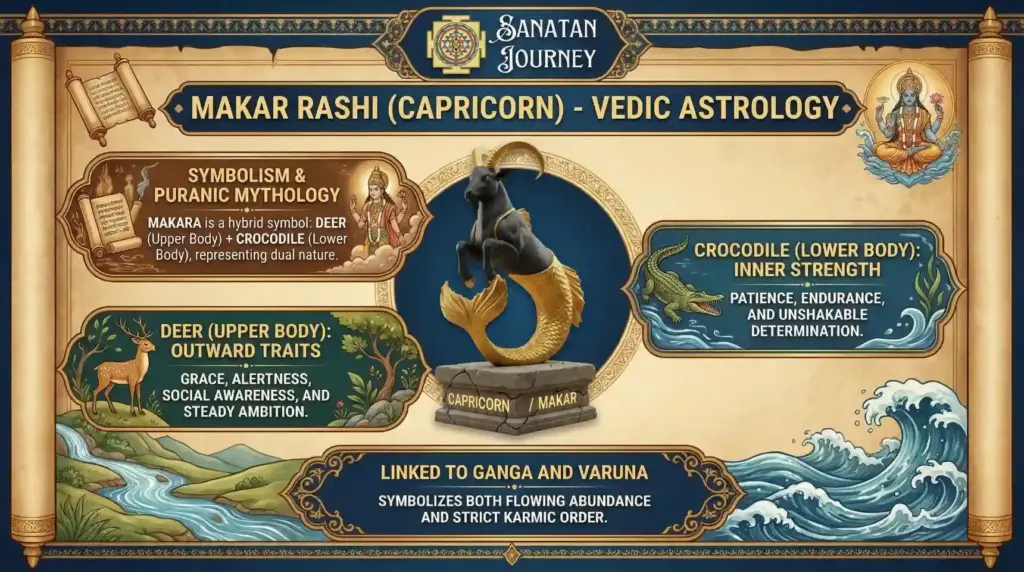
The upper body is that of a deer, and the lower body is that of a crocodile or a great sea-beast. And that combination isn’t random at all.
The deer’s head tells you something about social grace, alertness, and ambition. A deer moves through the forest carefully — always watchful, always reaching for the next patch of fresh ground.
That’s the Makar Rashi personality in public: composed, socially aware, and quietly goal-driven. You won’t see a Makar Lagna person rushing blindly into anything.
Now look at the crocodile’s tail. That’s a completely different story. Below the surface, there’s raw tenacity — a grip that doesn’t let go once it locks on. The crocodile doesn’t chase prey; it waits, it endures, and when the moment comes, it holds firm.
That’s Makar’s hidden depth. The patience, the unyielding grasp on material reality, the ability to survive in rough terrain — all of that lives in the tail.
In Puranic tradition, the Makara is the vahana (divine vehicle) of both Goddess Ganga and Lord Varuna, the god of cosmic waters and cosmic law. This connects Makar Rashi directly to two powerful forces — flowing abundance and karmic order.
BPHS also associates Capricorn with marsh lands, watery places, and wandering creatures like alligators and beasts, pointing to its dual existence — moving between the earthly and the watery, between the visible world and the hidden depths beneath it.
So when you look at the Makara symbol, you’re really looking at two truths existing at once: social ambition on the surface, and immovable tenacity underneath.
Fundamental Nature & Tattva
At its core, Makar Rashi is an Earth sign — but not the kind of earth you might be thinking of. Taurus, the other prominent earth sign, carries fertile, soft, productive soil.
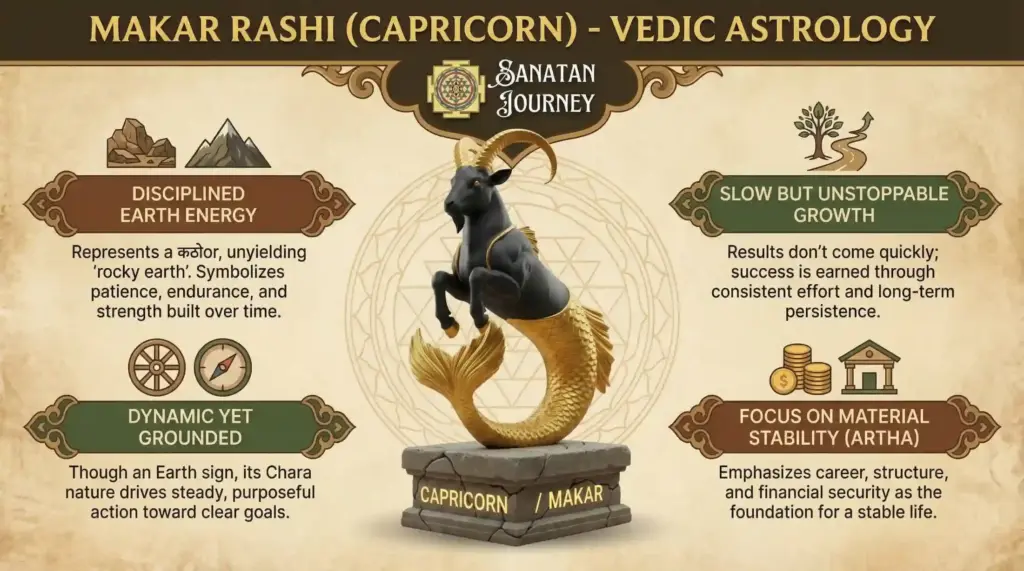
Capricorn’s earth is something else entirely. Think rocky mountain terrain. Think hard ground that doesn’t give easily, that demands effort from anyone who wants to climb it.
This is Prithvi tattva in its most disciplined form. Earth, according to BPHS and classical Vedic philosophy, carries the quality of being constant and solid.
In Makar, that solidity becomes an almost geological stubbornness — a slow, immovable strength that accumulates over time. You don’t get results fast in Capricorn energy. You earn them.
Now here’s the interesting twist: Makar is a Chara (Movable/Cardinal) sign. So while the earth beneath it is hard, the energy itself is not static. Chara signs are ruled by Brahma, the Creator — they carry the impulse to initiate, to move, to begin.
In Makar Rashi, this plays out as persistent, calculated movement. Not frantic rushing — more like the steady march of someone who has a clear destination in mind and will not stop until they reach it.
The Purushartha of Makar is Artha — material prosperity and security. This is the sign that links karma directly to tangible results.
Resources, structure, career, financial stability — these are what Makar Rashi natives build their lives around. It’s not greed; it’s the understanding that a solid material foundation makes everything else possible.
Planetary Dignities & Relationships
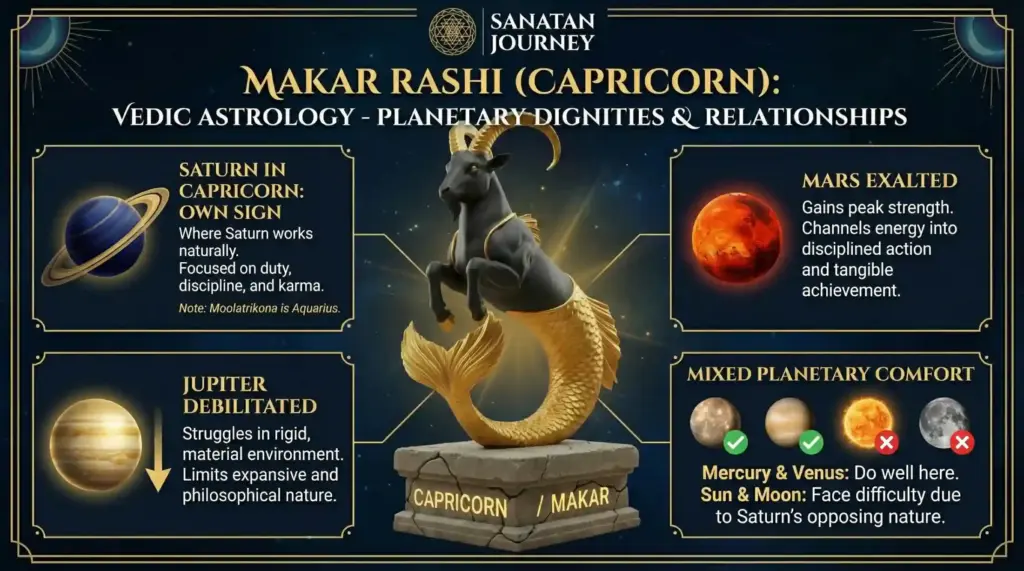
To really understand Makar Rashi, you need to look at which planets thrive here and which ones struggle. This is where things get genuinely fascinating.
Shani (Saturn) owns Capricorn, but here’s a detail most people miss: Saturn’s Moolatrikona sign is actually Aquarius, not Makar. As BPHS clarifies, a Moolatrikona is like a planet’s formal office — where it performs its duty with full authority. Makar, by contrast, is Saturn’s own rasi — more like its physical workplace where the daily grind gets done. Saturn is completely at home here, executing karma without ceremony or fanfare.
Mangal (Mars) reaches its uchcha (exaltation) in Makar, with peak strength at 28 degrees. As a cardinal earth sign, Capricorn gives Mars the disciplined structure it needs to channel raw ambition into focused, productive action. Mars doesn’t just fight here — it achieves.
Guru (Jupiter), however, is neecha (debilitated) at 5 degrees in Capricorn. Jupiter is a Brahmin planet — expansive, philosophical, and idealistic. Tamasic, goal-driven Capricorn runs against everything Jupiter stands for. The earth is too hard, too defined, too karmic for Jupiter’s free-flowing wisdom.
Mercury and Venus both find Capricorn friendly territory. Saturn counts them among his natural friends, as BPHS confirms. Mercury’s earthy, analytical nature thrives in this structured sign, and Venus finds enough practical beauty here to work with.
Sun and Moon, however, face challenges. Both are natural enemies of Saturn, and Capricorn’s cold, disciplined environment doesn’t suit the Sun’s royal assertion or the Moon’s emotional sensitivity.
Nakshatra Divisions
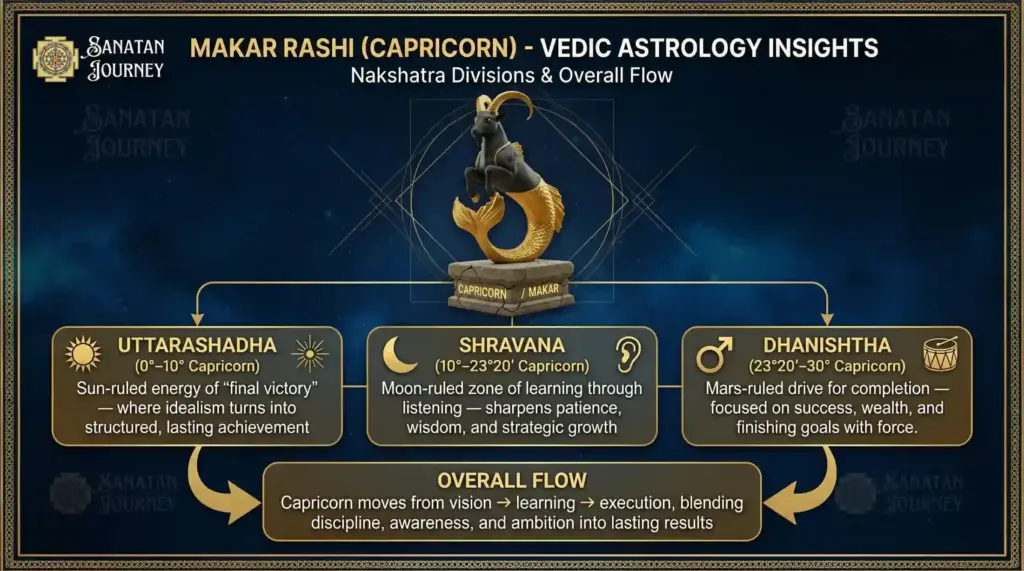
Uttarashadha (Padas 2, 3, 4) — 0° to 10°00′
The first stretch of Capricorn belongs to Uttarashadha, whose ruling planet is the Sun. The name itself means “Final Victory” — and that theme runs deep here.
Uttarashadha carries the energy of a long struggle that is finally, permanently, won. There’s no going back on an Uttarashadha victory; it sticks.
This pada zone sits right at the border between Sagittarius’s grand idealism and Capricorn’s hard realism. Planets placed here in a Vedic chart often carry that internal shift — the moment when big dreams meet the ground, and the person learns that real achievement demands real structure. Sun-ruled Uttarashadha gives these early degrees of Makar a solar quality: dignified, responsible, and quietly proud.
Shravana (All 4 Padas) — 10°00′ to 23°20′
The middle stretch of Makar Rashi belongs entirely to Shravana, ruled by the Moon. Shravana means “to listen,” and this nakshatra carries the energy of learning through careful attention — absorbing, processing, and retaining.
This feels like an unusual overlay for the stoic Capricorn, doesn’t it? But it makes complete sense. The most successful Makar energy isn’t just about grinding — it’s about listening to the right signals, learning from experience, and adjusting the path without losing direction.
BPHS lists Capricorn’s qualities as including wit, patience, and being a perfectionist — and a lot of that sharpness comes from Shravana’s influence.
Moon-ruled Shravana adds a scholarly, receptive layer to an otherwise unemotional sign, giving Makar natives a quiet depth that others often underestimate.
Dhanishtha (Padas 1, 2) — 23°20′ to 30°00′
The final degrees of Capricorn fall under Dhanishtha, ruled by Mars. Known as the “Star of Symphony,” Dhanishtha connects wealth, rhythm, and martial ambition. With Mars already exalted in Capricorn, this nakshatra feels especially powerful here.
Planets in Dhanishtha’s Capricorn padas carry a driven, completion-oriented energy. They want to finish what they started. This is the part of Makar that doesn’t just want success — it wants the full symphony of material achievement, played out to the last note.
Combined with Mars’s exaltation energy, Dhanishtha padas bring the final push that makes Capricorn’s ambition concrete and lasting.
Major Karakatvas (Significations)
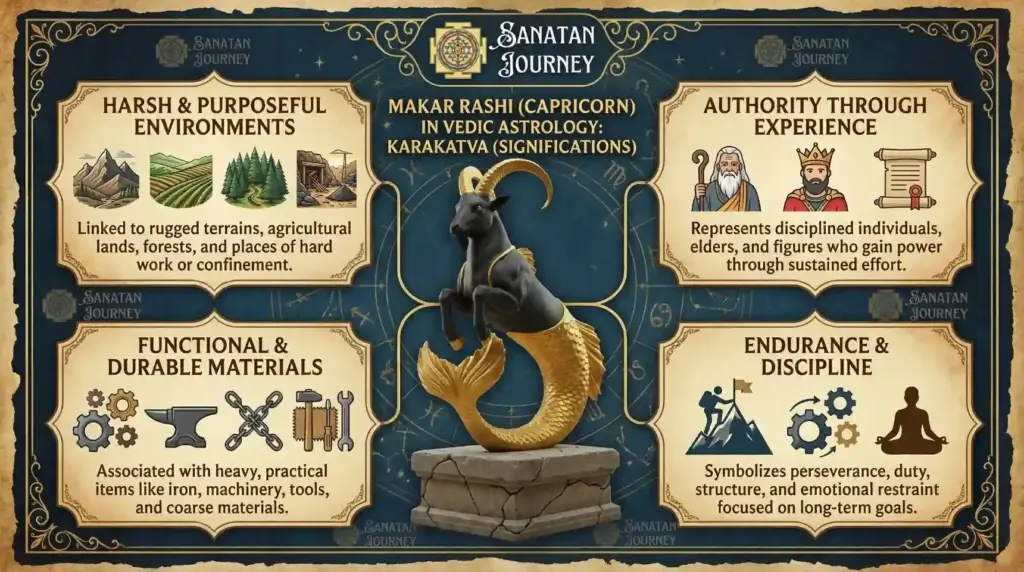
Every rashi in Vedic astrology signifies specific places, living beings, objects, and qualities. For Makar Rashi, these significations carry a consistent theme — hard terrain, endurance, and authority earned through effort.
Places
Capricorn rules places that demand physical labour or carry a sense of austere purpose. BPHS associates Makar with marsh lands, watery places, and forests. Extend that logic and you get agricultural lands where people work the earth, mountainous regions where the ground is rocky and unforgiving, rivers flowing through rugged terrain, and institutions of confinement or hard labour like prisons. These aren’t glamorous locations — they’re places where real work gets done, quietly and persistently.
Living Beings
The creatures of Makar Rashi reflect its dual nature. BPHS directly lists alligators, beasts, and aquatic animals as Capricorn’s significations — echoing the Makara symbol itself.
Among human archetypes, Capricorn governs the elderly, the authoritative, and the institutionally powerful. Think senior government officials, experienced managers, or anyone whose authority comes from years of disciplined service rather than inherited status.
Objects and Items
Capricorn’s material significations run toward the heavy and the functional. Iron, stones, agricultural tools, heavy machinery, coarse fabric — these aren’t objects of beauty, but of utility. If it builds something lasting or sustains physical labour, Makar Rashi likely governs it.
Abstract Qualities
This is where Capricorn’s character really shows. Perseverance heads the list — the capacity to keep moving when things are slow and difficult. Add to that organizational skill, a strong sense of duty, traditionalism, and a certain emotional coolness that others sometimes mistake for indifference. In fact, it isn’t coldness — it’s discipline. Makar Rashi energy doesn’t get distracted by feelings when there’s work to be done.
Anatomy & Medical Astrology
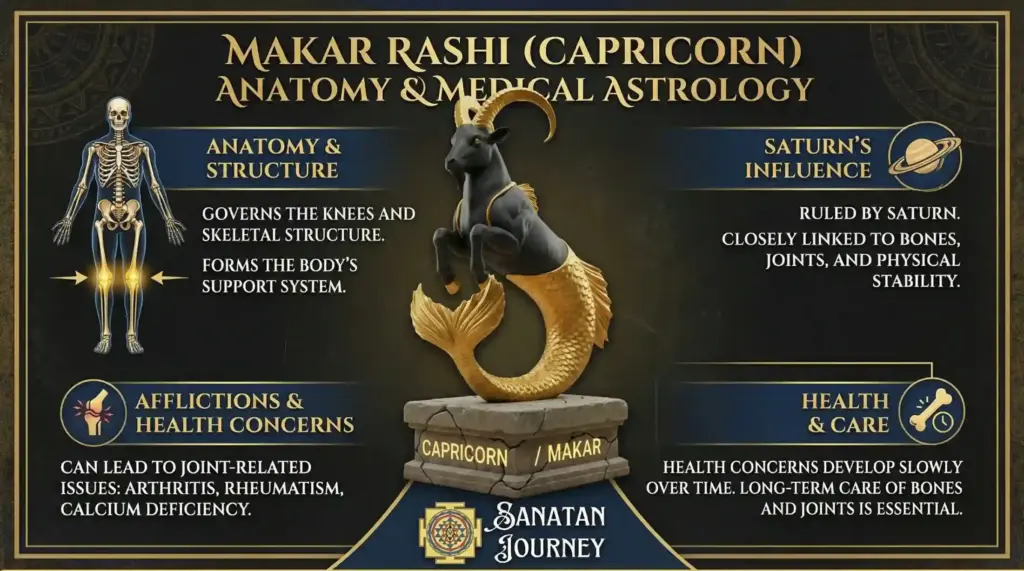
In the Kaal Purush Kundali, each sign governs a specific part of the body. BPHS places Capricorn at the knees — the joints that quite literally carry you forward and allow you to climb.
Internally, Makar Rashi rules the skeletal system, specifically the knee joints, kneecaps, and the broader structural framework that holds the body upright.
This makes complete anatomical sense for a sign governed by Saturn, the planet of bones and muscles. When Shani or the Capricorn sign itself faces affliction in a birth chart — through malefic conjunctions, harsh aspects, or difficult dasha periods — the body tends to signal trouble through these areas first.
Common health vulnerabilities for an afflicted Makar include arthritis and rheumatism, which affect the joints directly, along with skin conditions, calcium deficiencies, and general skeletal brittleness as one ages.
Saturn also governs the slow and the chronic — so health issues linked to Capricorn rarely arrive suddenly. They build quietly over time, which is why regular attention to joint health, bone density, and calcium intake becomes especially worthwhile for people with a strong Makar influence in their Vedic chart.
Strength Factors (Day/Night & Rising)
Rising Type: Prishtodaya
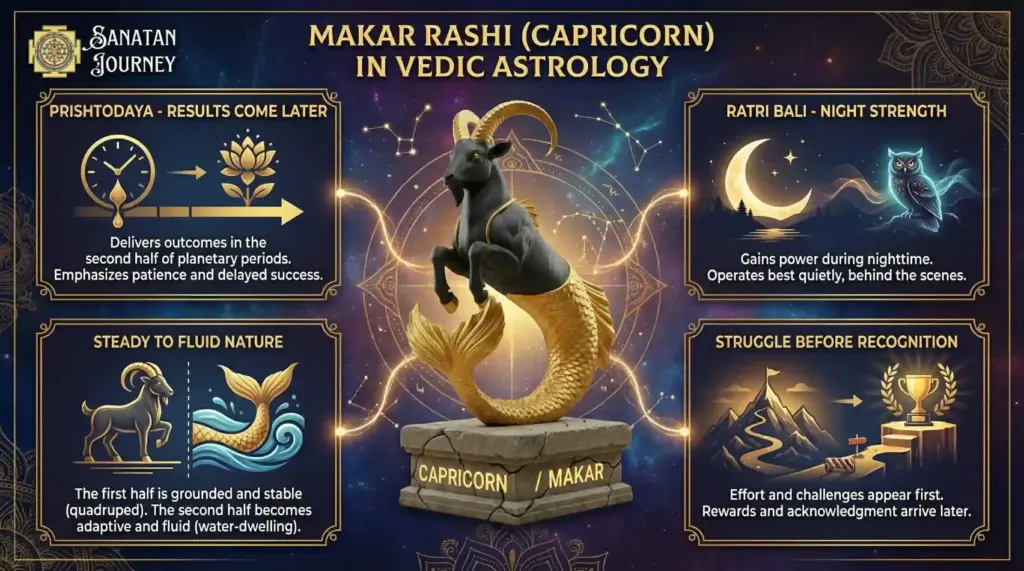
BPHS classifies Capricorn as a Prishtodaya rashi — meaning it rises with its back first. In practical terms, this tells you something important about timing. Planets placed in Prishtodaya signs tend to deliver their results in the second half of their dasas, not the first.
For Makar Lagna natives and those with key planets in Capricorn, this reinforces what the sign already teaches: patience pays off, and rewards come later rather than sooner. The back rises before the head — struggle comes first, recognition follows.
Time Strength: Ratri Bali
Capricorn is a night-time rashi — Ratri Bali — meaning it draws its strength during the night. This aligns perfectly with Saturn’s own nocturnal nature and explains why Makar energy often works quietly, away from the spotlight.
Quadruped and Water-dwelling Nature
This is a fascinating detail from classical Vedic astrology. The first half of Makar functions like a quadruped sign — grounded, land-based, steady on its feet. The second half shifts into a footless, water-dwelling nature — echoing the crocodile’s tail of the Makara symbol. This dual quality adds nuance when judging the strength and expression of planets placed in different degrees of the sign.
Personality Traits (Ascendant/Moon)
Physical Appearance
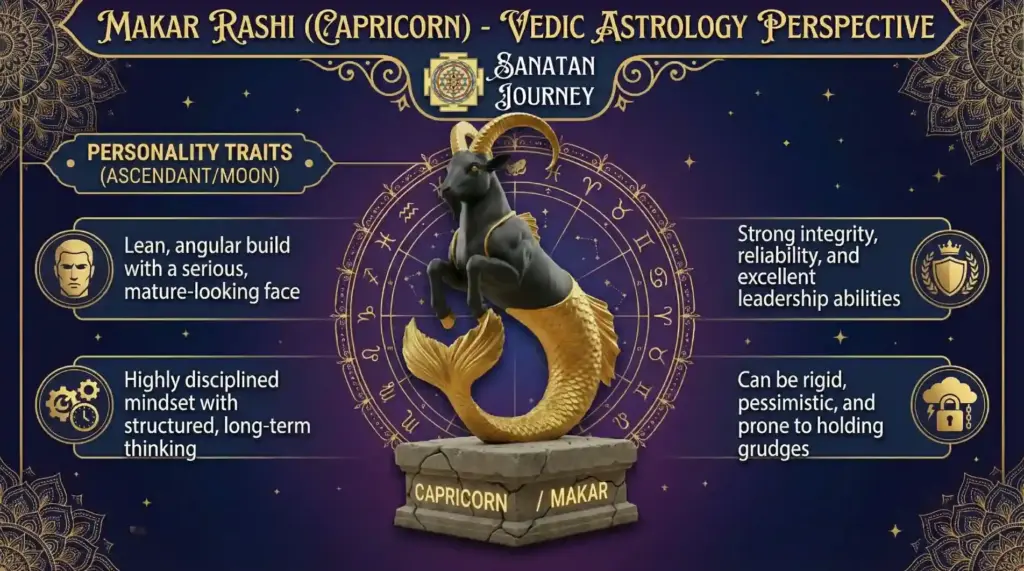
BPHS describes Capricorn with a slender build, a long neck, and prominent teeth. Extend that to the full physical picture and you get a lean, somewhat angular frame with noticeable knees — after all, that’s the body part Makar rules.
The face often carries a serious, composed look — the kind of expression that reads as older than the person’s actual age. You’ll meet a twenty-year-old Makar Lagna and think, “this person has seen things.”
Mental Temperament
Disciplined. That’s the first word. Makar Rashi natives carry a deep internal structure — they think in systems, plans, and timelines. Saturn’s influence brings a natural scepticism toward shortcuts, so don’t try selling a Capricorn on any get-rich-quick scheme.
They won’t buy it. There’s also a melancholic thread running through this sign — a quiet awareness of life’s hardships that gives Makar natives emotional depth, even when they don’t show it openly.
Positive Traits
The strengths of a Capricorn Rashi personality are genuinely impressive. Integrity sits at the top — Makar people keep their word. Endurance follows closely: they can outlast almost anyone in a slow, grinding situation.
Reliability is baked in. And executive ability — the capacity to organise, delegate, manage, and execute — makes them excellent in any role that demands sustained responsibility over a long period.
Negative Traits
The shadow side of Capricorn is real and worth knowing. Rigidness can make Makar natives resistant to new ideas, even good ones. Pessimism sometimes clouds their judgment, making a workable path look impossible.
They can lean too heavily into material concerns at the expense of relationships and inner life. And when someone wrongs them? They don’t forget easily. That tendency to hold grudges — quietly, without drama — is perhaps Capricorn’s most Saturn-like quality of all.

Frequently Asked Questions
What is the lucky stone for Makar Rashi?
Blue Sapphire (Neelam) is generally recommended, but always consult an astrologer based on Shani’s placement first.
Which planet is exalted in Makar?
Mars reaches exaltation in Capricorn, gaining sharp discipline and focused, productive ambition at 28 degrees.
Is Makar a lucky sign?
Yes — but luck here comes through consistent karma. Results arrive late, but they genuinely last.
What is the deity for Makar Rashi?
Lord Shiva and Lord Hanuman are traditionally worshipped by Capricorn natives to balance and appease Shani’s energy.
Which career suits Makar Rashi best?
Engineering, administration, law, government service, and traditional business sectors align naturally with Capricorn’s disciplined, structured energy.
Why is Jupiter debilitated in Makar?
As BPHS explains, Capricorn’s tamasic, material structure directly restricts Jupiter’s expansive, philosophical, and free-flowing nature.