

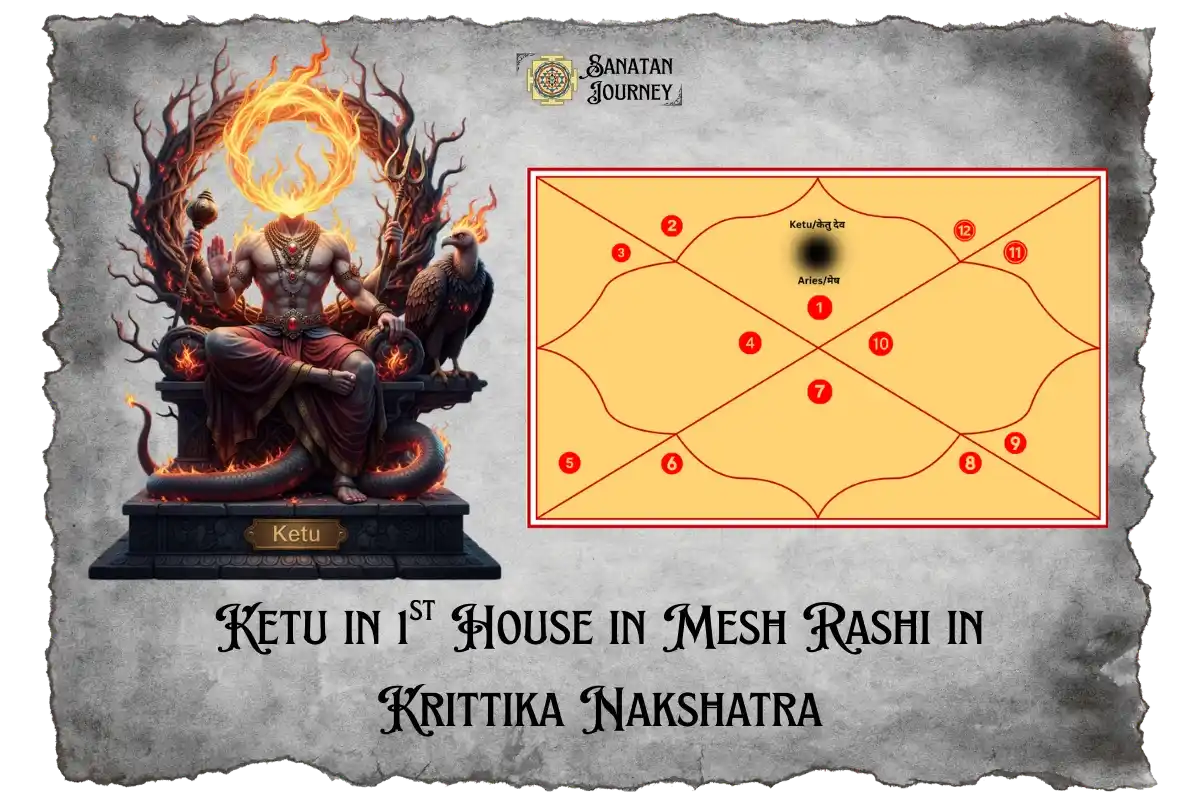
You might be wondering about the result of Ketu in 1st house in Mesh Rashi in Krittika Nakshatra and how it shapes your personality. In Vedic astrology, the 1st house shows your “true self” and vitality, while Ketu is the “moksha karaka” or planet of spiritual liberation. This placement combines Ketu in 1st house’s tendency for withdrawal and spirituality with the dynamic, Mars-like energy of Mesh Rashi Ketu.
With the sharp influence of Krittika Nakshatra, this combination mixes fire and detachment. You may feel a strong pull toward self-discovery, as this shadow planet effects your identity by blending the need for action with a deep desire for spiritual astrology and inner silence.
Disclaimer: This is a general analysis of the result of Ketu in 1st House in Mesh Rashi in Krittika Nakshatra. The information provided is intended solely for educational and informational purposes. It is not a definitive or personalized prediction. For an accurate and comprehensive kundali (horoscope) analysis, the native is strongly advised to consult a qualified professional astrologer.
Detailed Analysis of Ketu
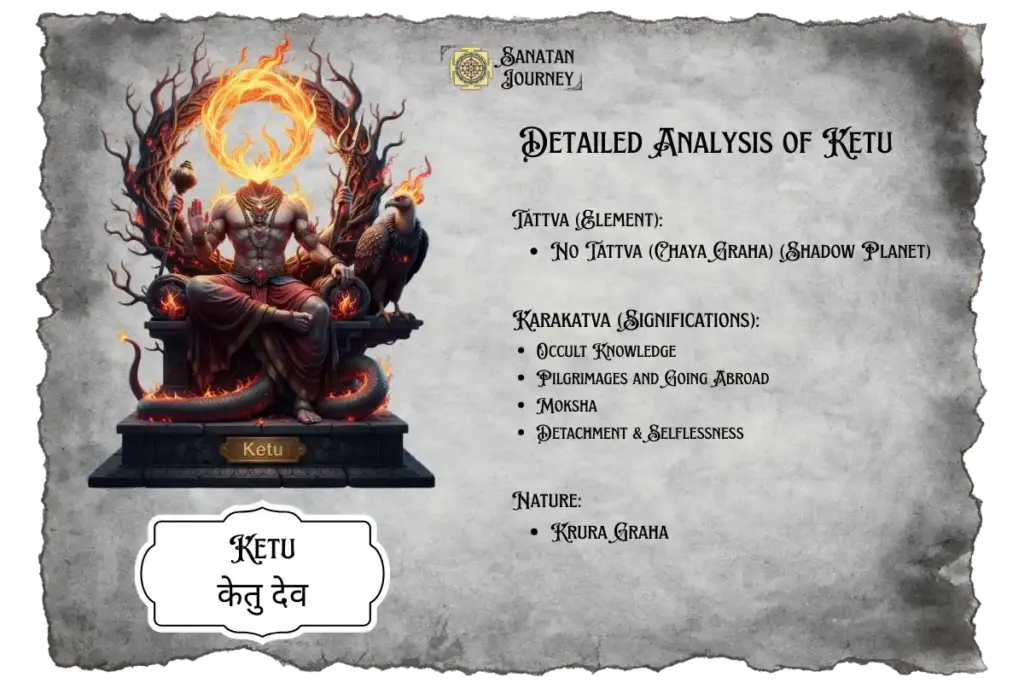
Tattva (Element)
In Vedic astrology, all grahas (planets) are associated with one of the five primary elements, known as pancha maha-bhutas. These elements are Fire (Agni), Earth (Bhoomi), Air (Vayu), Water (Jala), and Ether (Akasha).
Ketu’s element is not explicitly listed in the standard planetary element section, which assigns elements only to the five non-luminary planets (Mars, Mercury, Jupiter, Venus, Saturn). However, in broader Vedic astrological tradition, Ketu is often associated with the Fire element, similar to Mars, due to its fiery, penetrative nature. This fiery quality aligns with its placement in Mesh Rashi (Aries), a fire sign, amplifying the heat and intensity of this combination.
Karakatva (Significations)
Ketu is classified as a chāyā graha (shadow planet), representing a mathematical point known as the South Node of the Moon. It is often depicted as the “tail of the dragon,” symbolizing a headless body acting on instinct and past karma.
Moksha and Spirituality: Ketu is the primary moksha karaka (significator of liberation). It governs detachment, renunciation, and the final exit from the cycle of birth and death. Its influence pulls you toward spiritual astrology and inner silence.
Occult and Mystery: Ketu has a natural affinity for 8th-house themes like the occult, secrets, and research. It thrives in the mysterious and unseen, making you naturally curious about the hidden aspects of life.
Separation: As a planet of negation, Ketu signifies separation, loss, and cutting ties. In the 1st house, this can manifest as a sense of detachment from your own physical self or personality.
Nature (Saumya/Krura)
Ketu is classified as a krūra (cruel) or pāpa (malefic) graha. This doesn’t mean it is “evil,” but rather that its methods are harsh and intense.
Intense Action: As a natural malefic, Ketu operates through sudden events, shocks, and forceful disruptions. It breaks attachments to force spiritual growth.
Dissatisfaction: Ketu creates a sense of inherent dissatisfaction with the material world. It makes you feel that “something is missing,” driving you to look beyond the physical realm for answers.
Karmic Correction: Its malefic nature is often a tool for karmic balancing, forcing you to confront past actions and clear your karmic debts.
Planetary Relationships
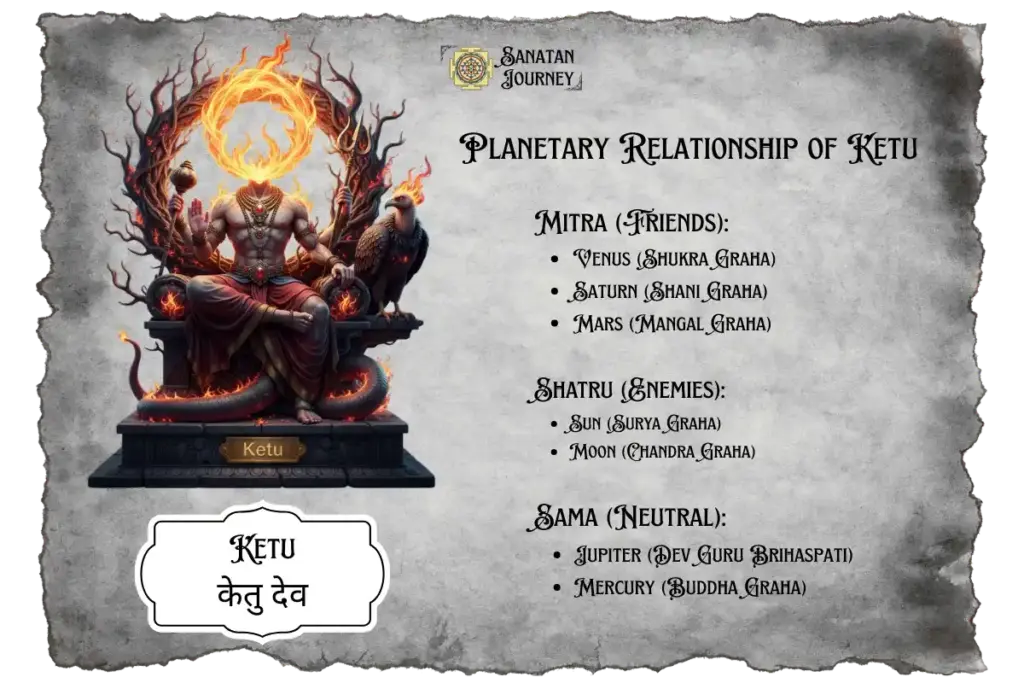
Understanding Ketu’s friends and enemies helps in analyzing its strength and comfort in a chart.
Friends (Mitra)
- Mars: Ketu behaves like Mars (Kujavat Ketu) and is comfortable in Mars’ signs (Aries and Scorpio).
- Venus: Often considered a friend.
- Saturn: Generally friendly, as both share qualities of detachment and separation.
Enemies (Shatru)
- Sun: Ketu is an enemy of the Sun (and Moon), as it causes eclipses.
- Moon: The Moon is a natural enemy of Ketu.
Neutrals (Sama)
- Mercury: Typically considered neutral toward Ketu.
- Jupiter: Often viewed as neutral or even friendly in spiritual contexts.
Dignity and Strength
In Vedic astrology, a planet’s dignity (strength based on sign placement) reveals how comfortably it can express its energy. For Ketu, these placements are debated among sages, but widely accepted views are:
Exaltation (Uchcha): Ketu is exalted in Sagittarius (Sg). Here, its spiritual and philosophical nature blends perfectly with Sagittarius’ quest for higher truth and dharma, allowing Ketu to give its highest results of wisdom and liberation.
Debilitation (Neecha): Ketu is debilitated in Gemini (Ge). In Gemini, an air sign ruled by Mercury, Ketu’s desire for withdrawal conflicts with the sign’s need for communication and connection, often creating confusion or scattered mental energy.
Own Sign (Swarashi): Ketu rules Scorpio (Sc). As a co-ruler with Mars, Ketu feels at home in Scorpio’s deep, mystical, and transformative waters, supporting research, occult studies, and psychological breakthroughs.
Mooltrikona: Ketu’s mooltrikona sign is Pisces (Pi). This is its “office” where it performs its core duty of moksha (liberation). In the 12th sign of the zodiac, Ketu is most effective at dissolving boundaries and guiding the soul toward spiritual release.
Aspects (Drishti)
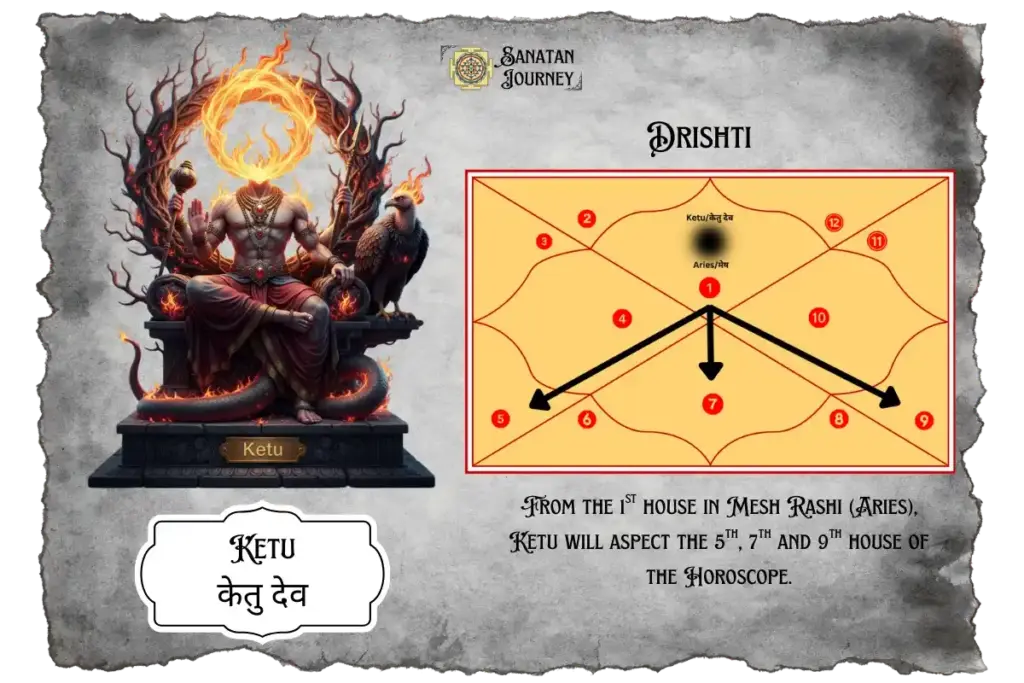
Ketu, being a headless “shadow planet,” does not cast a physical gaze like other planets. However, in practice, many Vedic astrologers attribute specific aspects to it, mirroring the aspects of Rahu (its counterpart):
5th Aspect: From the 1st house, Ketu aspects the 5th house. This influences your intelligence, creativity, and children, often adding a unique or detached flavor to these areas.
7th Aspect: From the 1st house, Ketu aspects the 7th house of marriage and partnerships. This can bring detachment or unusual circumstances in relationships.
9th Aspect: From the 1st house, Ketu aspects the 9th house of dharma, higher learning, and father. This can lead to unconventional spiritual beliefs or a non-traditional path in higher education.
States (Avasthas)
Age-Related States (Balādi Avasthās)
Planets are classified by “age” based on their degree in a sign:
- Infant (0-6°)
- Adolescent (6-12°)
- Youth (12-18°)
- Old (18-24°)
- Dead (24-30°)
For example, if your Ketu is at 15° in Aries (an odd sign), it is in the Youth (Yuva) state, capable of delivering its full effects. If it is at 28°, it would be in the Dead (Mrita) state, offering little to no results.
Alertness States
These states describe the planet’s level of consciousness:
Jagrita (Awake): When a planet is in its own or exaltation sign. It is fully alert and gives maximum results.
Swapna (Dreaming): When in a friend’s or neutral’s sign. Its results are medium or mixed.
Sushupta (Sleeping): When in an enemy’s or debilitation sign. It is dormant and gives negligible results.
In your case, Ketu in Aries (ruled by friend Mars) would likely be in the Swapna (Dreaming) state, moderately active but not fully awake.
Mood and Attitude States
These describe the emotional flavor of the planet:
- Deepta (Bright): When exalted (e.g., in Sagittarius).
- Mudita (Delighted): When in a friend’s sign (e.g., in Aries). This suggests Ketu is relatively comfortable and “happy” to express its energy here.
- Duhkhita (Distressed): When in an enemy’s sign.
- Kopa (Angry): When combust (too close to the Sun).
Activity States
These metaphorical states (like Sayana for lying down, Bhojana for eating, Nidra for sleeping) offer highly specific predictions.
For example, a planet in Bhojana (eating) might indicate enjoyment of resources, while Nidra (sleeping) suggests inactivity. These are calculated using complex formulas involving the planet’s position and time of birth.
Analysis of the Lagna Bhava (First House)
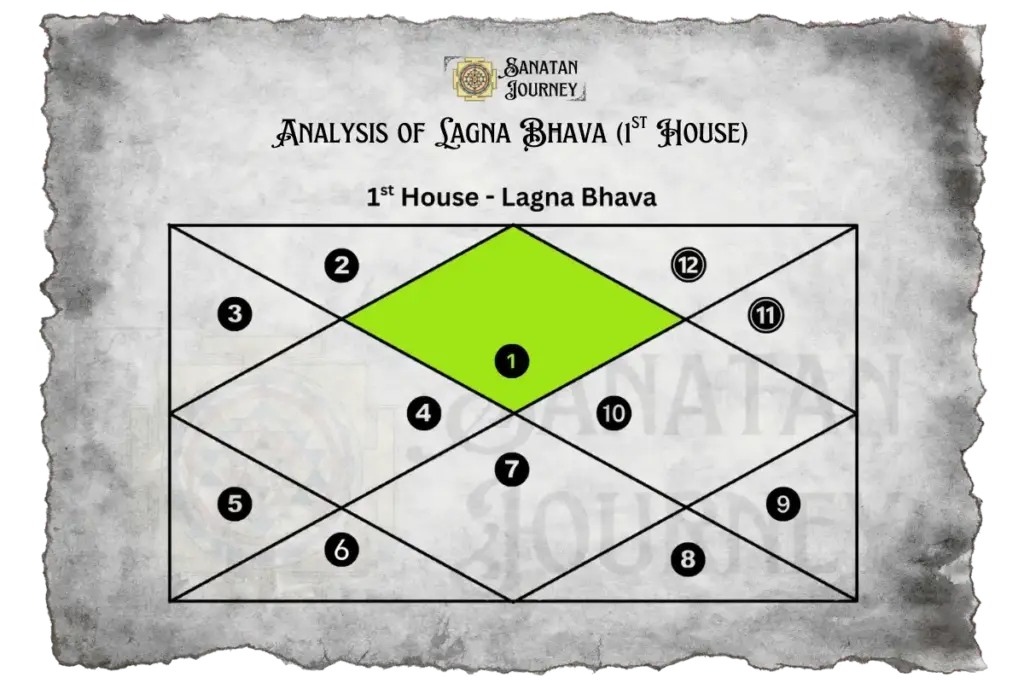
Governing Areas
In Vedic astrology, the 1st house (Lagna) is the most critical house in a chart, serving as the foundation for the entire horoscope. It governs the physical body, appearance, complexion, constitution, and overall vitality. It also represents the “true self,” personality, character, and the general path of life. Essentially, it is the lens through which you experience the world and how the world perceives you.
Planet’s Impact on the House
When Ketu in 1st house is placed in Mesh Rashi (Aries) and Krittika Nakshatra, the influence on the Lagna analysis is profound. Ketu, being a planet of detachment and moksha, naturally withdraws energy from the physical self. This creates a personality that is less focused on outer validation and more attuned to the inner or hidden dimensions of existence.
With Ketu in ascendant, you may feel a sense of separation from your own physical identity, often leading to a humble or introverted demeanor. The fiery nature of Mesh Rashi Ketu combined with the sharp energy of Krittika Nakshatra adds a layer of intensity and purification. You are likely drawn to spiritual astrology, self-inquiry, and transformative experiences rather than material accumulation.
Example
With Ketu in 1st house, the native’s personality is infused with Ketu-like qualities—more inward, less attached to outer validation, and drawn to deeper/hidden dimensions of life. This placement suggests a life path focused on self-identity astrology and moksha karaka Ketu themes, where the individual seeks to understand the ‘true self’ beyond the physical form.”
Analysis of the Mesh Rashi (Aries)
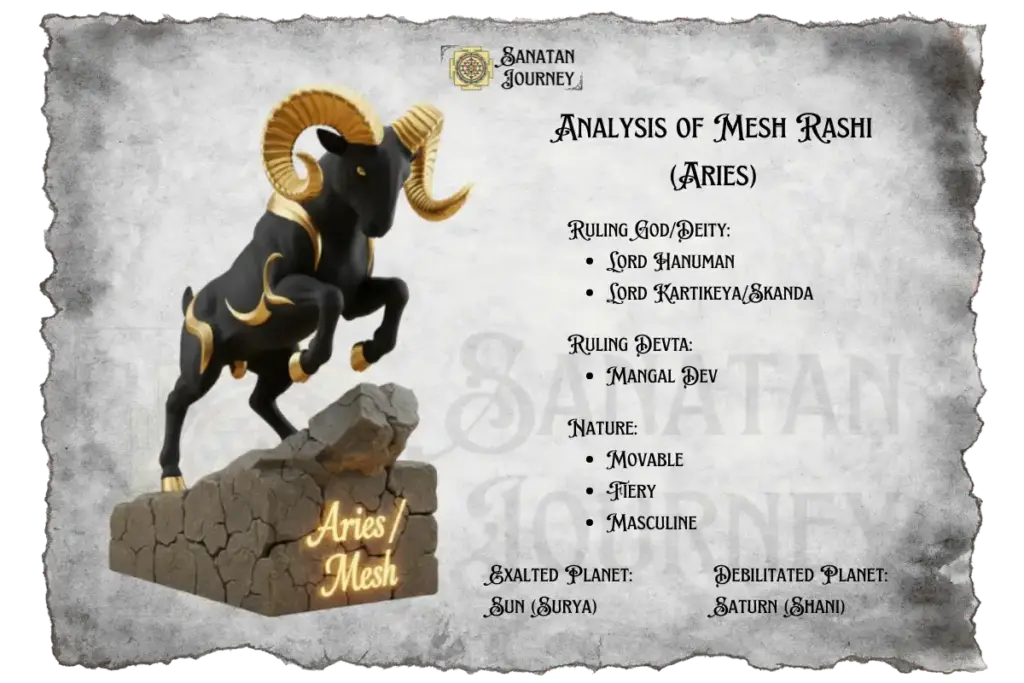
Sign Characteristics
Mesh Rashi (Aries) is the first sign of the zodiac and corresponds to the head in the natural zodiac mapping (Kaal Purusha). It is a fiery, movable (chara) sign ruled by Mars, embodying qualities of initiative, courage, and dynamism. Aries is known for its enterprising spirit, impulsive nature, and a strong drive to lead and conquer. It represents the “I am” principle—the spark of individuality and the raw energy of creation.
Planet–Sign Synergy
The synergy between Ketu in Aries creates a unique and paradoxical energy. Aries is all about self-assertion and “doing,” while Ketu is about “undoing” and detachment.
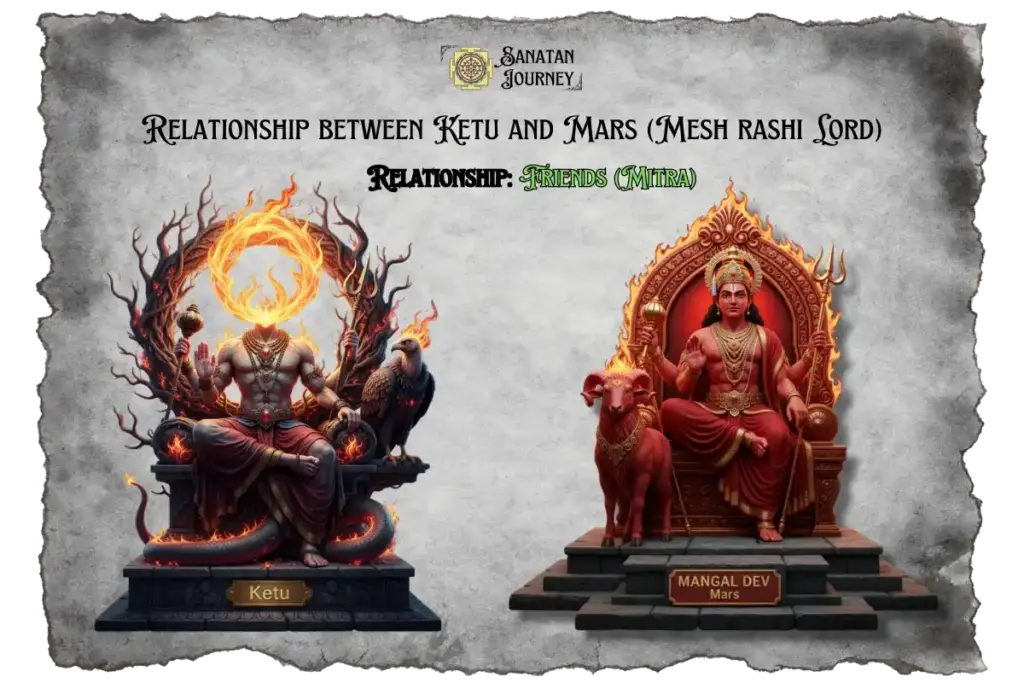
Detached Warrior: This placement creates a “spiritual warrior.” The dynamic energy of Aries is filtered through Ketu’s lens of detachment. You may have a strong drive (Aries) but feel disconnected from the outcome (Ketu). It’s like fighting a battle not for the prize, but for the sake of duty or karma.
Impulsive Withdrawal: The impulsiveness of Aries can manifest as sudden withdrawals or unexpected shifts in direction. You might dive into projects with great enthusiasm (Aries) and then suddenly lose interest or walk away (Ketu) once the initial spark fades or the karmic lesson is learned.
Headless Action: Since Ketu is “headless” and Aries rules the head, this combination can sometimes lead to action without forethought. However, on a higher level, it represents action guided by intuition rather than logic.
Dignity Note: Ketu does not have a specific exaltation or debilitation point in Aries. However, since it is in a friendly sign (Mars is a friend to Ketu) and shares a similar fiery nature, it is considered strong and comfortable here. This placement allows Ketu to express its transformative and penetrating qualities effectively, albeit with a Martian flair.
Analysis of the Krittika Nakshatra
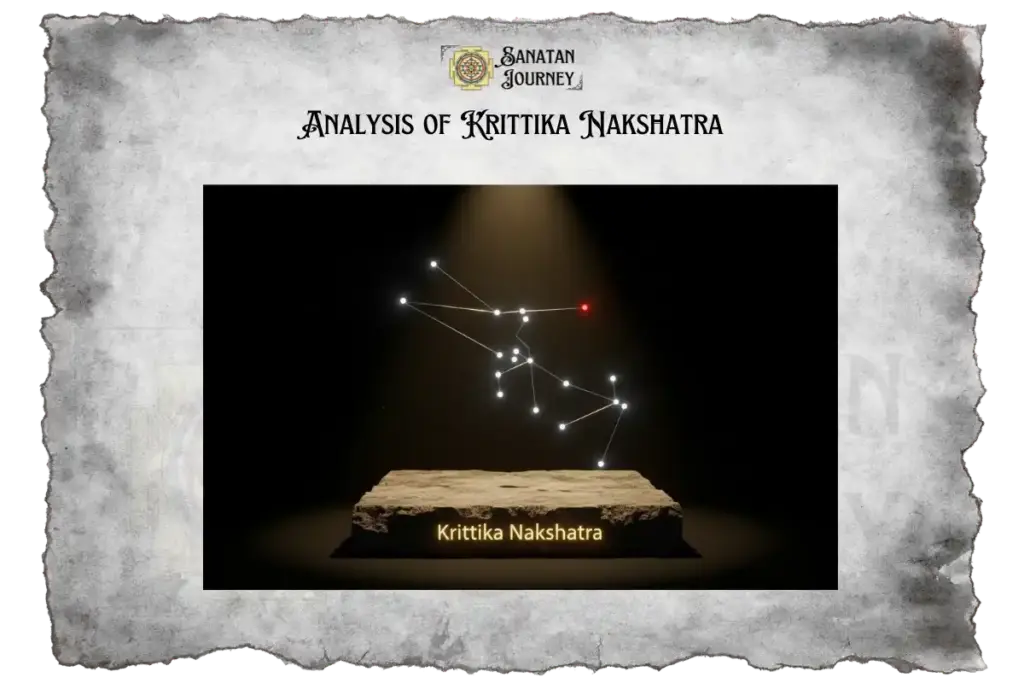
Nakshatra Characteristics
Krittika Nakshatra, often symbolized by a razor or a flame, is positioned from 26°40′ Aries to 10°00′ Taurus. It is known as the “Star of Fire” and represents purification, cutting ties, and intense transformation. Its primary motivation is kama (desire), but in a purified, spiritual sense—burning away impurities to reach the truth. The razor symbolism highlights its sharp, critical, and sometimes cutting nature, which aligns with Ketu’s separative influence.
Nakshatra Lord and Deity
Lord: The planetary ruler of Krittika is the Sun.
Deity: The ruling deity is Agni, the god of fire.
Planet–Nakshatra Lord Synergy
The relationship between Ketu in Sun nakshatra is complex. Ketu is a shadow planet representing eclipse and liberation, while the Sun represents the soul, ego, and illumination.
Eclipse of Ego: Ketu in a Sun-ruled nakshatra like Krittika suggests a “solar eclipse” of the ego. The natural authority and leadership of the Sun (and Krittika) are internalized. Instead of seeking outer recognition (Sun), you seek inner illumination (Ketu).
Fiery Purification: The deity Agni and the fiery nature of Ketu create a double-fire energy. This is not just physical heat but spiritual fire (tapas). This placement indicates a soul that is undergoing a rigorous purification process, burning away past karmas and egoic attachments to reveal the true self.
Detached Authority: The Sun gives authority, but Ketu gives detachment. You may possess natural leadership skills or commanding presence but feel indifferent toward wielding power or being in the spotlight.
Degree Note (for accuracy)
Krittika spans from 26°40′ Aries to 10°00′ Taurus. Therefore, “Ketu in Mesh Rashi in Krittika” specifically places Ketu in the Aries portion of Krittika (26°40′–30°00′ Aries), which is the first pada (quarter) of the nakshatra. This section is highly Martian and fiery, intensifying the sharp, cutting qualities of the placement.
Detailed Predictions (by life area)
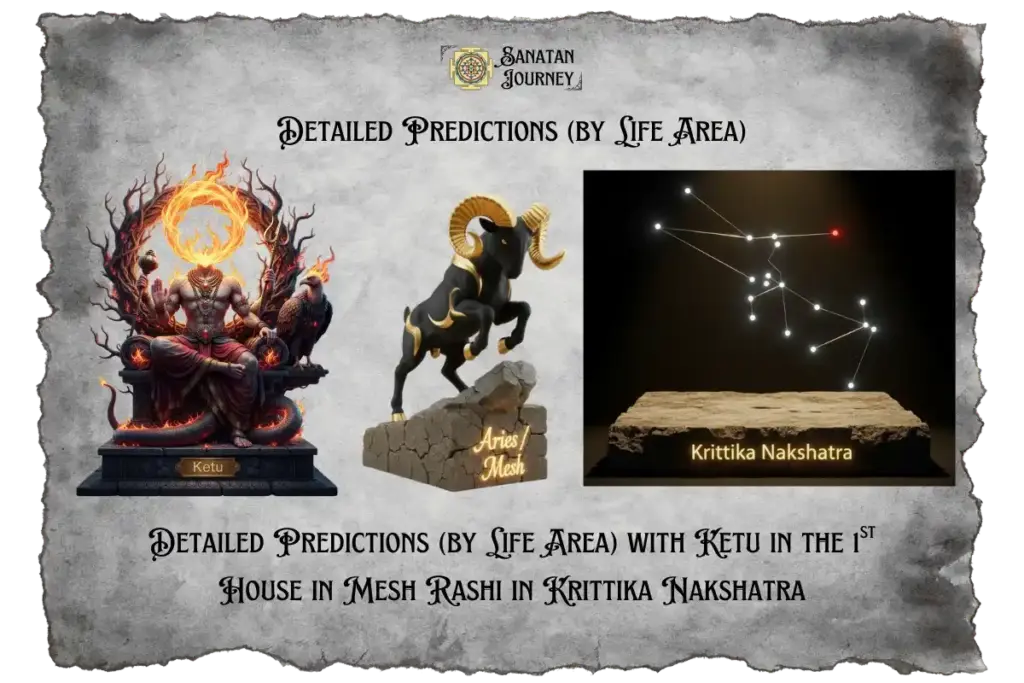
Personality and Character
With Ketu in 1st house in Mesh Rashi (Aries) and Krittika Nakshatra, your core personality is a fascinating blend of fiery independence and spiritual detachment. You are naturally introverted or “in your head,” often appearing mysterious or reserved to others. The Martian energy of Aries gives you a strong drive, but Ketu’s influence means this drive is directed inward—toward self-mastery rather than external conquest.
The “razor” quality of Krittika Nakshatra makes you highly analytical, sharp, and capable of cutting through illusions. You may have an innate ability to see the truth, often questioning societal norms and seeking a deeper purpose beyond the ego-driven “I”.
Career and Public Image
Your career path is likely unconventional, favoring roles where you can work independently or “behind the scenes.” The authority of the Sun (Krittika’s lord) combined with Ketu’s research-oriented nature makes you excellent in fields requiring precision and deep investigation.
Suitable Paths: Research, surgery/medicine (cutting/healing), occult sciences, investigative journalism, or spiritual counseling. The Krittika influence also supports roles in government or administration, but you may prefer an advisory role rather than being the public face.
Public Image: Society perceives you as competent and intense but perhaps “hard to read.” You are respected for your integrity and depth, even if you don’t actively seek the spotlight.
Health and Well-being
Since Aries rules the head and the 1st house governs the physical body, this placement can make you prone to head-related issues.
Vulnerabilities: Migraines, fevers, eye strain, or minor injuries to the head/face due to the fiery (Pitta) nature of Krittika and Mars. Ketu can also bring “mysterious” or hard-to-diagnose symptoms, often rooted in stress or psychic tension.
Strengths: Your resilience and ability to recover quickly are high. Spiritual practices like meditation are essential to cool down the intense mental heat generated by this combination.
Relationships and Partnerships
Your relationships are heavily influenced by the Ketu-Rahu axis. With Ketu in the 1st house, Rahu is in the 7th house (Libra), creating a karmic pull toward partnerships.
7th House Aspect: Ketu’s 7th aspect on the house of marriage can create a sense of detachment from partners. You might feel “alone” even when in a relationship or attract partners who are unconventional, foreign, or karmically “fated”.
Dynamics: You may struggle to balance your need for solitude (Ketu) with your partner’s need for connection (Rahu). Learning to engage in relationships without losing your sense of self is a key lesson here.
Strengths and Weaknesses
Strengths:
- Deep Insight: You have a penetrating intellect that sees past surface-level lies.
- Resilience: The Aries spirit gives you the courage to walk a lonely path if it leads to truth.
- Spiritual Focus: You are naturally wired for moksha and self-realization.
Weaknesses:
- Isolation: You may inadvertently cut people off or become too reclusive.
- Impulsiveness: The fiery energy can lead to rash decisions or sudden withdrawals.
- Health Anxiety: You might over-analyze physical symptoms or feel disconnected from your body.
Overall Prediction and Results of Ketu in 1st House in Mesh Rashi in Krittika Nakshatra
First House (Tanu Bhava)
The 1st House represents the self, physical body, and overall identity. Its key significations include:
- Physical body: Appearance, complexion, and overall physique.
- Vitality: General health, energy levels, and immunity.
- Self-image: Personality, intelligence, fame, and how one projects oneself to the world.
- Birth: The nature of one’s birth and early childhood environment.
Results of Ketu in 1st House:
When Ketu is placed in the 1st house in Mesh Rashi (Aries) and Krittika Nakshatra, the native develops a “headless” or detached approach to self-identity. The fiery nature of Aries and Krittika (ruled by Sun/Agni) creates immense internal heat and spiritual drive, but Ketu directs this energy inward.
The native may often feel disconnected from their physical body or experience a sense of not belonging to their immediate environment. They are likely to be intuitive, investigative, and fiercely independent, yet uninterested in taking credit for their actions. This placement can make the person a “spiritual warrior”—one who fights battles not for ego but for a higher truth.
Ketu’s Aspects:
5th Aspect on 5th House (Leo): Ketu casts a 5th aspect on Leo (ruled by Sun). This aspect creates detachment regarding children, romance, and speculative gains. It enhances spiritual intelligence and mantra siddhi but may cause dissatisfaction in romantic relationships or delays in progeny matters.
7th Aspect on 7th House (Libra): This is the direct gaze on the house of partnerships where Rahu resides. It creates a push-pull dynamic in relationships, where the native craves connection (Rahu) but instinctively withdraws (Ketu) when things get too intimate or demanding.
9th Aspect on 9th House (Sagittarius): Ketu’s 9th aspect falls on Sagittarius (ruled by Jupiter). This is a highly spiritual aspect, fostering a deep interest in philosophy, religion, and higher knowledge. It may lead to unconventional beliefs or a separation from the father/guru figure in early life, eventually leading to finding one’s own spiritual path.
Second House (Dhana Bhava)
The 2nd House relates to resources and immediate family. Its significations are:
- Wealth: Accumulated assets, bank balance, and financial stability.
- Family: Lineage, close family members, and early upbringing.
- Speech: Tone of voice, truthfulness, and communication style.
- Food: Eating habits and dietary preferences.
Results:
With Ketu in the 1st house, the 2nd house is ruled by Taurus (Vrishabha). While Ketu does not aspect this house, its presence in the Ascendant influences the native’s values. The native may have a detached or fluctuating attitude toward accumulated wealth.
They might possess money but feel no strong attachment to it. Speech can be blunt or sharp due to the Mars-ruled Ascendant, but also truthful. Family ties might feel karmic or burdensome, leading the native to seek independence from family lineage early on.
Third House (Sahaja Bhava)
The 3rd House governs siblings, courage, and communication. Its primary meanings are:
- Siblings: Younger brothers/sisters and relationship with them.
- Courage: Initiative, bravery, and mental strength.
- Communication: Writing, journalism, and short-distance travel.
- Body Parts: Throat, ears, shoulders, and arms.
Results:
The 3rd house falls in Gemini (Mithuna). The native is naturally curious and intellectually agile. With the Ascendant Lord (Mars) influencing the chart’s energy, there is a strong drive for self-initiated action. The native is courageous but in a quiet, understated way.
Relationships with younger siblings might be intellectual but emotionally distant. Communication style is likely logical and precise, though the native may prefer written over verbal communication to avoid unnecessary social engagement.
Fourth House (Sukha Bhava)
The 4th House is the foundation of happiness and domestic life. It represents:
- Mother: Relationship with mother and maternal figures.
- Assets: Home, property, land, and vehicles.
- Inner Peace: Emotional stability, childhood, and formal education.
- Comfort: Luxuries and general contentment.
Results:
The 4th house is in Cancer (Karka). Emotional security is a key theme, but with Ketu in the 1st house, the native may struggle to find “home” in the external world. True peace is found in solitude or spiritual retreat.
There might be a deep, psychic bond with the mother, yet also a sense of separation or misunderstanding. The native may change residences frequently or live in secluded places. Happiness comes from inner contentment rather than material comforts or large properties.
Fifth House (Putra Bhava)
The 5th House is associated with creativity, intelligence, and progeny. Its significations include:
- Progeny: Children, pregnancy, and parenting.
- Intellect: Creative intelligence, scholarship, and wisdom.
- Karma: Poorvapunya (past life merit) and spiritual practices.
- Romance: Love affairs, speculation, and artistic expression.
Results:
The 5th house is in Leo (Simha). As mentioned, Ketu casts its 5th aspect here. This creates a strong potential for spiritual creativity but detachment from worldly romance. The native may have a unique or unconventional approach to parenting.
There could be difficulties in conceiving or a lack of desire for children. However, this is a powerful placement for mantra chanting, ancient studies, and accessing past-life talents. The native’s intelligence is sharp, intuitive, and often ahead of its time.
Sixth House (Ari Bhava)
The 6th House deals with obstacles, health, and service. It signifies:
- Enemies: Competitors, rivals, and conflicts.
- Health: Acute diseases, injuries, and immune system.
- Service: Daily work, employment, and employees.
- Debts: Financial liabilities and litigation.
Results:
The 6th house falls in Virgo (Kanya). The native is highly analytical and detail-oriented in dealing with problems. They are likely to conquer enemies through strategy and intellect rather than brute force. Health issues may be related to digestion or nerves (Virgo).
The native has a service-oriented nature but prefers to work autonomously. Debts are usually managed well, as the native is naturally cautious and averse to unnecessary bondage.
Seventh House (Yuvati Bhava)
The 7th House (in Libra) is the primary indicator of partnerships and marriage. Its key meanings include:
- Spouse: Marriage partner, marital life, and sexual relationships.
- Business: Partnerships, trade, and contracts.
- Travel: Long journeys and foreign residence.
- Maraka: Being the 7th house, it is a “killer” house representing death or transformation.
Results:
When Ketu is in the 1st house, Rahu is automatically in the 7th house in Libra. This axis creates a powerful karmic pull toward relationships. The native often attracts partners who are unconventional, foreign, or from a different cultural background. Rahu in the 7th house creates an intense desire for connection, but Ketu in the 1st house makes the native fundamentally detached.
Marriage: There may be sudden or unconventional marriages, or relationships that feel “fated” but are emotionally turbulent. The partner might be demanding or materialistic (Rahu traits).
Ketu’s 7th Aspect: Ketu casts its direct 7th aspect on the 7th house. This aspect adds a layer of spiritual separation. Even within a marriage, the native may feel like an observer rather than a participant, leading to periods of isolation or withdrawal.
Eighth House (Randhra Bhava)
The 8th House (in Scorpio) governs longevity, transformation, and hidden matters. It represents:
- Longevity: Lifespan and the cause of death.
- Crisis: Sudden events, accidents, and chronic diseases.
- Wealth: Inheritance, unearned wealth, and insurance.
- Occult: Secret knowledge, mysticism, and research.
Results:
With Scorpio in the 8th house (ruled by Mars), the native has a natural affinity for the occult and hidden truths. Ketu in the 1st house (also ruled by Mars) intensifies this connection. The native may experience sudden transformations or “ego deaths” throughout life.
There is a potential for injuries or surgeries related to the head or face (Mars influence). However, the native possesses deep regenerative powers and can bounce back from crises with renewed spiritual strength. Unearned wealth may come through inheritance or sudden gains, but it may not bring lasting happiness.
Ninth House (Dharma Bhava)
The 9th House (in Sagittarius) relates to fortune, higher wisdom, and righteousness. Its significations include:
- Father/Guru: Relationship with father, mentors, and spiritual teachers.
- Fortune: Luck, prosperity, and long-distance travel.
- Spirituality: Religion, philosophy, and higher education.
- Dharma: Righteous conduct and moral values.
Results:
With Sagittarius in the 9th house (ruled by Jupiter), the native is naturally inclined toward philosophy and higher learning.
Ketu’s 9th Aspect: Ketu casts a 9th aspect on this house. This creates a unique spiritual dynamic. The native may reject traditional religious dogmas in favor of a personal, direct experience of truth. Relationships with the father or gurus may be distant or unconventional.
The native is likely to travel to spiritual places or seek wisdom in foreign lands. This aspect blesses the native with deep intuitive wisdom and a strong moral compass, though it may be outside societal norms.
Tenth House (Karma Bhava)
The 10th House (in Capricorn) is the primary indicator of one’s career and actions in society. It signifies:
- Career: Profession, job, and business.
- Status: Reputation, fame, and social standing.
- Authority: Government, bosses, and leadership roles.
- Karma: Actions performed in the outer world.
Results:
Capricorn (ruled by Saturn) in the 10th house indicates a hardworking and disciplined approach to career. With Ketu in the 1st house, the native may not be driven by fame or recognition. They prefer to work quietly and efficiently.
The career may involve research, analysis, or fields related to the past (history, archaeology) or the future (technology, astrology). The native is respected for their integrity and competence, but they may frequently change careers or feel dissatisfied with worldly success, seeking a vocation that aligns with their spiritual values.
Eleventh House (Labha Bhava)
The 11th House (in Aquarius) governs gains, income, and social networks. Its meanings are:
- Income: Profits, salary, and realization of desires.
- Networks: Friends, elder siblings, and social circles.
- Aspirations: Hopes, dreams, and long-term goals.
- Body: Ankles and circulation.
Results:
Aquarius (ruled by Saturn and Rahu) in the 11th house suggests that gains come through unconventional means or large networks. However, Ketu in the 1st house can make the native indifferent to social circles. They may have a few close friends rather than a large entourage.
Financial gains may fluctuate, or the native may not prioritize material accumulation. Friendships are likely to be intellectual or spiritual in nature. The native may eventually detach from social obligations to pursue solitary goals.
Twelfth House (Vyaya Bhava)
The 12th House (in Pisces) represents loss, expenses, and the subconscious. It signifies:
- Expenses: Financial losses, charity, and spending.
- Isolation: Hospitals, prisons, and ashrams.
- Subconscious: Sleep, dreams, and hidden fears.
- Moksha: Spiritual liberation and enlightenment.
Results:
Pisces (ruled by Jupiter) in the 12th house is a powerful placement for spiritual liberation. Ketu in the 1st house (Aries) and the 12th house (Pisces) share a subtle connection through the “beginning and end” of the zodiac. This placement indicates a soul that is nearing the end of its karmic cycle.
The native may have vivid dreams, intuitive flashes, or a strong desire for solitude. Expenses may be incurred on spiritual pursuits or charity. The native is likely to find peace in isolation, meditation, or foreign lands, moving toward Moksha (liberation).
Ending Note
In Vedic astrology, Ketu in 1st house in Mesh Rashi Ketu (Ketu in Aries) in Krittika Nakshatra shapes a sharp, fearless personality that still feels different from the crowd. This South Node in 1st house combination supports karmic astrology themes around self-identity astrology: building courage without ego, and learning detachment and astrology in daily life.
Because Aries maps to the head, Ketu effects can show a strong will with periodic withdrawal, so Lagna analysis and Vedic chart interpretation should check supporting planets for balance.
Guiding thought: Treat the “cutting” power of Krittika as a tool—use meditation, simple routines, and honest self-review so moksha karaka Ketu turns shadow planet effects into clarity, not isolation.